


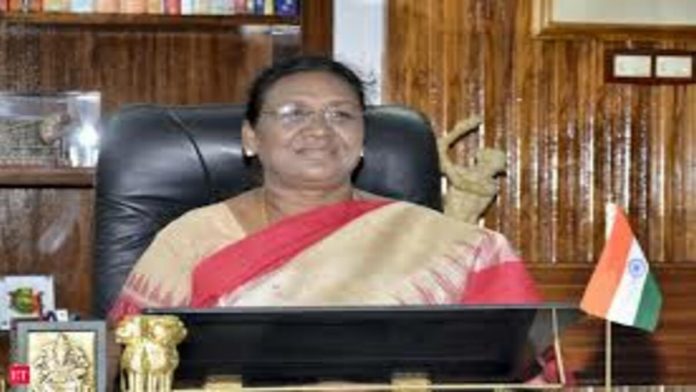
On Monday, lawmakers and parliamentarians from all around the nation cast ballots to choose the next president. By the time the voting was over, there were enough signs to predict that Droupadi Murmu, the NDA nominee, would easily defeat Yashwant Sinha, the opposition candidate.
On July 21, results will be announced, and on July 25, the new president will take office.
According to statistics, more than 99 percent of the eligible voters—771 members of Parliament (05 vacant), 4025 members of the Legislative Assemblies (06 vacant), and 02 disqualified voters—cast ballots today. However, Chhattisgarh, Goa, Gujarat, Himachal Pradesh, Kerala, Karnataka, Madhya Pradesh, Manipur, Mizoram, Puducherry, Sikkim, and Tamil Nadu claimed that all of their MLAs voted in full.
The EC stated that two MLAs, Anant Kumar Singh and Mahendra Hari Dalvi, were disqualified from participating in the election under Section 8 of the R P Act of 1951 as a result of the decision of the appropriate Court.
According to sources, eight MPs — Sunny Deol and Sanjay Dhotre of the BJP, Syed Imtiaz Jaleel of the AIMIM, Gajanan Kirtikar of the Shiv Sena, Mohammad Sadique of the Congress, T R Paarivendhar of the DMK, Haji Fazlur Rehman, and Atul Kumar Singh — did not cast a ballot (BSP).
Cross-voting incidents, primarily in Murmu’s favor, were recorded from a number of states, including Gujarat, Haryana, her native state of Odisha, where she served as governor, and Jharkhand. When the ballots are counted, it will be clear how many MPs and MLAs cross-voted.
Prime Minister Narendra Modi, his predecessor Manmohan Singh, who arrived in a wheelchair, Congresswoman Sonia Gandhi, key ministries, party leaders, and MPs cast their ballots in Room 63 of Parliament House. Along with Mulayam Singh Yadav, Nirmala Sitharaman, the minister of finance, and R. K. Singh, the minister of power, all arrived in wheelchairs.
Nearly 48% of the votes were cast for the BJP and its allies. With the support of regional parties including the BJD, YSRCP, BSP, AIADMK, TDP, JD(S), JMM, and Shiv Sena in addition to the SAD, Murmu is predicted to receive more than 60% of the vote, making her the first woman from a tribal group to hold the position of chief executive.
Despite the seeming certainty of the outcome, there was some excitement due to cross-voting rumors in several regions.
Kuldeep Bishnoi, a Haryana Congress MLA who cast a cross-vote in the Rajya Sabha elections last month, declared that he had backed the NDA candidate. He told reporters, “Like Rajya Sabha, I have voted in this election as per my conscience. When asked what he would do next, he responded, “I will announce this soon.”
Manpreet Singh Ayali, a SAD legislator, made the decision to abstain from voting and cited the BJP-led Centre, previous Congress administrations, as well as his own party, for failing to resolve issues pertaining to Punjab. He claimed in a video message that before agreeing to back Murmu, the party leadership had not consulted him or the Sikh community.
NCP MLA Kandhal Jadeja claimed to have supported Murmu in Gujarat. Jadeja received a show-cause warning from the NCP in 2020 for disobeying the whip and casting a cross-party vote in the Rajya Sabha elections. Jadeja had disobeyed the party line and supported BJP candidates in the Gujarat Rajya Sabha elections in 2017 and 2020 rather than the Congress. Kamlesh Singh, another member of his party in Jharkhand, also supported Murmu.
Mohammed Moquim, a Congress member from Odisha, declared he had supported Murmu because she was the “daughter of Odisha.” “My name is Odia. Due to the fact that Droupadi Murmu is an Odisha native, I voted in her favor. I followed my morals. It is impossible to stop MLAs from following their conscience, according to Moquim.
In Assam, a verbal battle broke out between the Congress and its former allies AIUDF. Karimuddin Barbhuiya, an AIUDF MLA, claimed to have proof that 20 members of the Opposition Congress had cast dissenting votes, but he did not present any. The Congress refuted the accusation and cited the absence of two AIUDF MLAs from the voting booth. Additionally, it stated that when Sinha visited Guwahati as part of his campaign, only two AIUDF MLAs attended a gathering there.
BJP leader Pradipta Kumar Naik arrived in a wheelchair in Odisha from the hospital where he was being treated for issues related to post-Covid. He was carrying an oxygen tank. Mithilesh Kumar, a BJP MLA who was hurt in a car accident approximately a month ago, arrived on a stretcher to cast his ballot in Patna.
And in Chennai, the first voter in the secretariat complex was the chief minister of Tamil Nadu, M K Stalin, who arrived at the polling place directly from the hospital after being released following his recovery from Covid.
The elected MPs and MLAs make up the electoral college that uses the proportional representation system to choose the president. Due to Jammu and Kashmir’s lack of an Assembly, the value of an MP’s vote in this Presidential election decreased to 700 from 708 votes. MPs, MLAs, and MLCs who have been nominated are ineligible to vote in this election.
Each MLA’s vote has a different value in each state. A MLA’s vote has a value of 208 in Uttar Pradesh, 176 in Jharkhand, and 176 in Tamil Nadu. Maharashtra’s is 175 miles. For instance, the number of votes cast for each MLA in Sikkim is seven, compared to nine in Nagaland and eight in Mizoram.
For the first time, the Commission also permitted Covid-19 positive voters to cast their ballots during the final hour of voting or after all non-Covid voters had finished casting their ballots. According to the EC, one Covid-positive MP voted in Thiruvananthapuram, while two Covid-positive electors cast their ballots in the Tamil Nadu Assembly.