


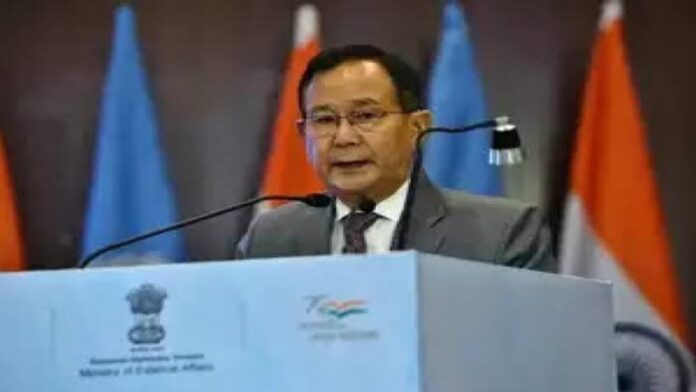
In an effort to resolve the Manipur problem, Union Minister Rajkumar Ranjan Singh has asked Prime Minister Narendra Modi to put in place a structure that can bring together respectable civil society organisations from the Meitei people and the Kuki-Zo tribes for earnest discussions.
In a letter to PM Modi, Mr. Singh claimed, without identifying anyone, that “some few political leaders, a handful of armed groups, and wrongly motivated scoundrels” are preventing Manipur from living in peace and returning to normalcy.
In the correspondence, the State Minister for External Affairs and Education urged the Prime Minister to guarantee that civil society groups (CSOs) on both ends “are not coerced or influenced by armed militias and insurgents.”
“Considering the fluid law and order situation due to the ethnic strife and tension, we may seriously start a people-to-people contact movement via CSOs of the Meiteis and the Kukis,” Mr Singh, who represents the Inner Manipur Lok Sabha seat, said in the letter to PM Modi.
“PMO (Prime Minister’s Office) may find some credible CSOs like the time-tested ‘Manipur Cultural Integration Conference’ on both sides and ask them to start negotiations for a practical, amicable solution,” the Union Minister said.
“Only people-to-people communication and understanding will show us the path for resolving the issues. Arms and bullets can’t bring about a solution. Violence begets violence. So let the peace-loving citizens start the negotiation at the ground level under the PMO’s patronage,” Mr Singh said in the two-page letter. NDTV has seen a copy.
“The Centre must ensure that they are not coerced or influenced by the armed militias or insurgents,” he added, alluding to the huge number of armed groups and people in Manipur who call themselves “village defence volunteers”.
There are hundreds of stolen firearms in use in Manipur. Arambai Teggol, a Meitei youth movement, has allegedly been using the crisis to achieve its own goals, according to the Manipur Police.
The twenty-five or so Kuki-Zo insurgent groups that have signed the tripartite suspension of operations (SoO) agreement with the state government and the Centre have been accused of using the safety net that the SoO agreement provides to extort money from motorists, murder civilians, and smuggle drugs into the hill areas.
“My honest reading is that common people desperately want restoration of peace and normalcy in Manipur. Some few political leaders, a handful of armed groups, and wrongly motivated scoundrels are not allowing it to happen… A strong intervention shall make both sides fall in line,” Mr Singh said.
The Union Minister emphasised the necessity of stationing the Border Security Force (BSF) adjacent to the border between Myanmar and India. Drawing from his personal experience, Mr. Singh stated that the BSF does a great job of securing borders.
“In the 70s (i.e. 50 years ago) as a young researcher, I did a lot of travelling along the Indo-Myanmar border for research and in personal interest. During those days the BSF was guarding the border and in every 20-30 km, there was a BSF post along the international boundary. We found them taking patrol to and fro along the border in the difficult hilly-forest terrain, even though there was no proper path or way,” Mr Singh said.
“Because of their strict vigil, there was hardly any intrusion or smuggling…” he said, referring to the widely cited issues in current day Manipur such as drugs smuggling and illegal immigration, which are seen as some factors behind the Manipur crisis.
Days have passed since Manipur Chief Minister N Biren Singh announced that BSF forces had begun to be stationed along the border with Myanmar, when the Union Minister made his remarks. Up till now, the Assam Rifles have been carrying out both border guard and counter-insurgency operations simultaneously. The army has operational control over them, while the Home Ministry has administrative supervision.
Ten months have passed since the start of the ethnic violence in Manipur, which is caused by disputes over land, resources, political representation, and affirmative action laws. There have been thousands of internal displacements and over 180 deaths.