


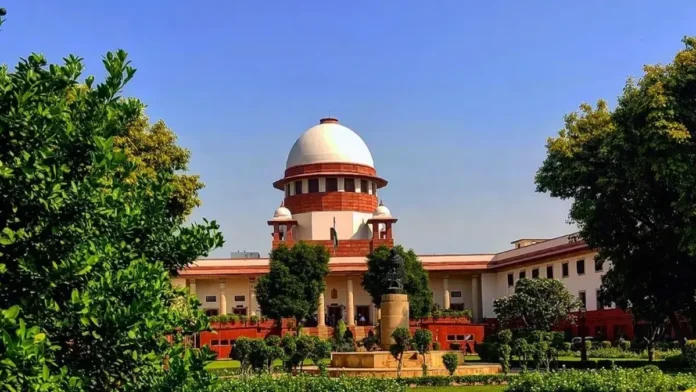
The Supreme Court’s decision that lottery distributors are exempt from paying service tax for holding lotteries is a comfort to lottery companies like Future Gaming and Hotel Services Pvt. Ltd. On Tuesday, the court affirmed a ruling by the Sikkim High Court that invalidated a 2010 statute that levied a service tax on things like lottery promotion and organization.
Lotteries are classified as “betting and gambling” under the Indian Constitution, which only state governments are allowed to tax, according to a bench made up of Justices B.V. Nagarathna and N. Kotiswar Singh. The court reaffirmed that the Center cannot levy service tax on such operations by rejecting the Union government’s appeal.
“There being no agency, no service is rendered by the respondent-assessees as agents to the Government of Sikkim. Therefore, service tax is not leviable on the transactions between lottery ticket purchasers and the Government of Sikkim,” stated Justice Nagarathna while reading out the judgment.
But according to the Supreme Court, lottery corporations are nonetheless responsible for paying any gambling taxes levied by a state under Entry 62 of the State List. The decision is supported by constitutional clauses that assign the federal government and the states different taxing authority. States are expressly authorized to tax gaming and betting, including lotteries, under Entry 62 of the State List (List II), and to regulate such activities under Entry 34 of the same list.
However, by using Entry 97 of the Union List (List I), which gives Parliament the authority to tax things not previously covered by the Constitution, the Center sought to impose service tax on lottery distributors. Since betting and gambling fall squarely under the State List, the Supreme Court ruled that only states have the power to impose taxes on lotteries, rejecting the Centre’s claims.
The disagreement started in 2010 when the Indian Parliament added Clause (zzzzn) to Section 65(105) of the Finance Act, 1994. Lottery distributors were liable to service tax as a result of this change, which categorized marketing, advertising, and lottery organization as taxable services.
This modification was contested in the Sikkim high court by lottery operators, such as Future Gaming and Hotel Services Pvt. Ltd., which distributes lottery tickets issued by the Government of Sikkim both online and on paper. They said that holding lotteries constitutes “betting and gambling,” which is solely subject to state authority in accordance with Entry 62, List II of the Indian Constitution, and that their operations do not qualify as “taxable service.” They further contended that Parliament lacks the authority to impose taxes on state subjects under Entry 97 of the Union List.
On 29 November 2012, the Sikkim high court ruled in favour of the lottery companies, striking down Clause (zzzzn) of the Finance Act, 2010. The high court held that lottery distributors do not provide a service and, therefore, cannot be subject to service tax. Additionally, it emphasized that gambling and betting are state topics and that only state governments have the authority to tax them. Later, the Center appealed this decision to the Supreme Court, but the Court rejected the Center’s case.
This decision is consistent with another 2024 case that determined that a state government’s sale of lottery tickets is an activity intended to raise extra money rather than a taxable service. The court pointed out that wholesale lottery buyers are exempt from service tax obligations since they are not advertising or marketing any state-provided services.