


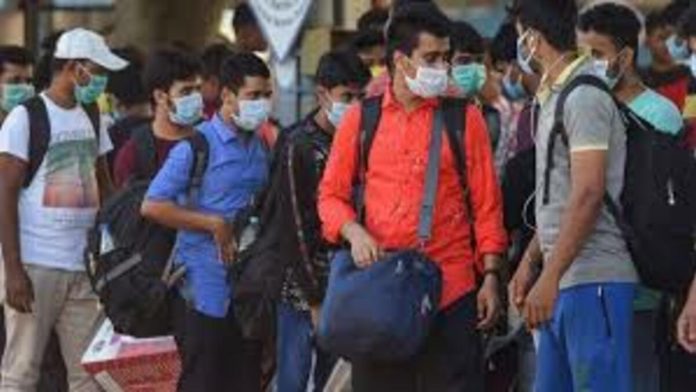
The actual method of coronavirus (SARS-CoV-2) transmission has remained a mystery. Previously considered to spread by contact with surfaces, epidemiologists have shown that countries whose citizens donned masks throughout the epidemic were less afflicted. However, there was no quantifiable evidence that the infection was spread through coronavirus particles (virions) in the air. However, the capability of Covid transmission across the radio has already been proven.
The airborne transmission of SARS-CoV-2 was confirmed in a study conducted by scientists from CSIR-CCMB, Hyderabad, and CSIR-IMTech, Chandigarh, in collaboration with hospitals in Hyderabad and Mohali. The results of the research have been published in the Journal of Aerosol Science.
The researchers looked at the coronavirus genome content in air samples taken from different Covid-19 patient regions. These samples were taken from hospitals, confined rooms where only Covid-19 patients spent a brief time, and the homes of Covid-19 patients who had been quarantined at home.
They discovered that the virus was regularly detected in the air around Covid-19 patients, and that the rate of positive rose as the number of patients on the premises grew. The virus was found in both ICU and non-ICU portions of hospitals, implying that patients released the virus into the air regardless of the severity of infection.
The researchers discovered live coronavirus in the air, which can infect living cells and travel across large distances. To prevent the spread of the sickness, scientists recommend that people continue to wear masks.
“Our findings indicated that, in the absence of ventilation, coronavirus can remain in the air for a long time in enclosed places.” “We discovered that when two or more Covid-19 patients were present in a room, the probability of obtaining the virus in the air was 75 percent, compared to 15.8 percent when one or no Covid-19 patient was present,” said Shivranjani Moharir, a scientist involved in the study.
“Our findings are consistent with earlier research that suggests the concentration of SARS-CoV-2 RNA in indoor air is higher than in outside air. “When compared to community indoor settings, the concentration is higher in hospital and healthcare settings that host a larger number of Covid patients,” Moharir added.
“Now that we’re back to doing things in person, air surveillance is a good way to estimate infection risk in places like classrooms and conference rooms.” Dr. Rakesh Mishra, the study’s principal scientist and AcSIR Distinguished Emeritus Professor at CCMB and Director of the Tata Institute for Genetics and Society, said, “This can assist enhance tactics to restrict the spread of viruses.”
He claims that the air monitoring technology may be used to track other airborne illnesses in addition to coronavirus.