


We don’t anticipate subversion in a Salman Khan movie. In Bajrangi Bhaijaan, Kabir Khan used his inner kid to express himself in a political setting. In Sikandar, writer-director AR Murugadoss tries to recast the star to outshine his critics, but he is unable to uncover depth in Salman’s on-screen character of “what you see is what you get.” The actor has taken the lead in the Eid present for his fans, possibly drawing inspiration from Shah Rukh Khan’s recent incredible success with self-reference in Pathaanand Jawan. The present, however, has not been presented effectively because it seems to be a public relations response to the recent occurrences in and around his personal life.
Salman portrays Gujarati prince Sanjay Rajkot, also known as Sikandar, who has a golden heart. We don’t learn much about this do-gooder, but his devoted wife (Rashmika Mandanna) feels a little neglected. In order to defend a woman, he once assaults a lewd boy in a moving aircraft. A war of attrition ensues when it is discovered that the boy is the home minister’s son. A rush of emotions brought on by a personal tragedy drives Sikandar to act violently. These days, it looks like Salman’s character is rendered colorless by the numerous dos and don’ts in his image-building or image-saving exercises. He is not seen chasing the girl or the pistol. This overt urge to be flawless makes the experience facile, as he invariably ends up like a Santa without a beard.
The storyteller goes to great lengths to explain to us how the character’s many names came to be syncretically. An Eid-style song opens the story, and a Holi song with absurd lyrics where Shambhu rhymes with tambu (pole) closes it out. Salman is seen protecting an elderly man wearing a skull hat and wearing saffron. To put it succinctly, politically correct items are automatically checked off. Our imagination is briefly thrown into overdrive by a home minister (Sathyaraj) with a bald pate shielding a dishonest son (Prateik Patil), but the outcome is somewhat unremarkable.
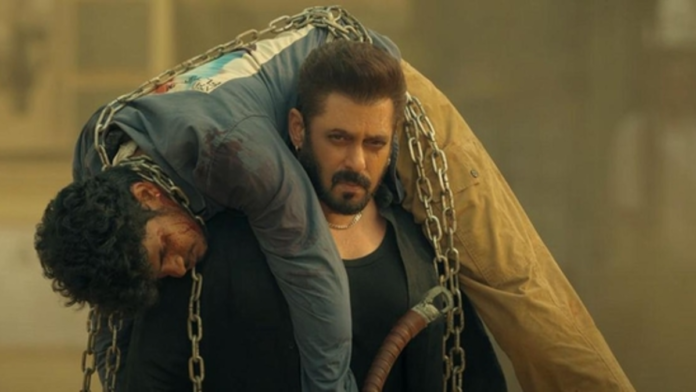
When the upper layer is as fertile as the bottom layer, thematic subversion is effective. Here, there is hardly anything to skim. The trick is that the audience is unaware of the transition from Salman Khan to Sikandar. But as it turns out, we find Salman sitting on the shoulders of Sikandar to spell out his good work and grievances. The tale either functions as a fictitious advertisement for Salman’s charitable endeavors or sounds like a threat that he will enter politics by continuously showing off his fan base if he is targeted further. This can be attributed to either laziness or overwriting. When he roars, “Qayde main rahoge toh fayde main rahoge (If you behave yourself, you will be safe),” it sounds like a reply to the recent attacks on him.
Pritam’s compositions are only marginally better than average. Although Murugadoss is renowned for adding a level of mystery in between action scenes, his storytelling is somewhat uninteresting in this instance. The lessons on organ donation and environmental and moral pollution feel forced and are replete with bumper sticker propaganda. There is also a critique of the alpha male, but it is all presented in a harsh and disjointed way, which makes it harder to sympathize with the actors’ predicament.
The problems are exacerbated by Salman’s rigid demeanor and clunky speech. There is not much originality in the action choreography. Without good camera work, it appears that people wait in line to be defeated by a celebrity whose agility is declining but whose determination is unwavering. With cliched lines, Rashmika adds another movie to her resume in which she serves to inflate the star’s self-esteem. Kajal Agarwal and Sharman Joshi haven’t done much to merit their inclusion. As though he is aware of what could have been done with this material, Sathyaraj continues to grind his teeth.
Bollywood may take a cue from the South and use Empuraan, which features its own Bajrangi, to fashionably express its political views. At the moment, Sikandar is showing in theaters.