


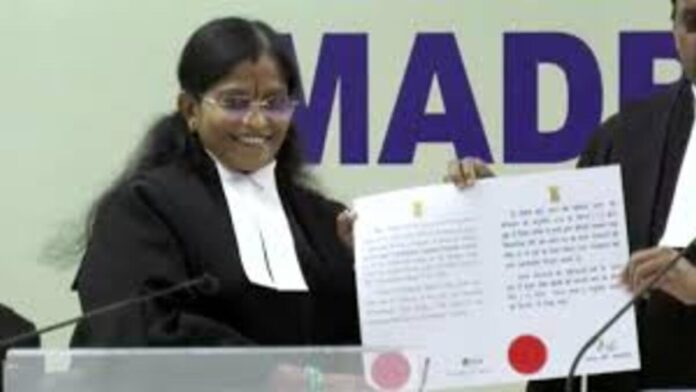
Less than 24 hours after the Union government announced attorney LC Victoria Gowri’s nomination as a judge in the Madras high court following a recommendation from the top court collegium, a stunning turn of events will see the Supreme Court on Tuesday entertain a motion to delay her swearing-in.
Gowri is scheduled to be sworn in as an additional judge of the Madras high court at 10.35 am, according to a circular released by the high court’s registrar general on Monday night. The petitions alleging that Gowri made hate speeches against Christians and Muslims are anticipated to be heard by a bench led by justice Sanjiv Khanna around 12 pm.
At 10.30 am, when the Supreme Court’s benches are in session, the case is likely to be brought up once more for a quick hearing.
The Supreme Court’s decision to overturn a high court judge’s nomination has only ever happened once in the history of the law. In 1992, the Supreme Court rejected the appointment of a state government official, ruling that he was ineligible to serve as a high court judge because he was a member of the judicial service.
The Gauhati High Court and the Centre were forbidden from taking the candidate’s oath of office during the case’s hearing, though. It would be a first for the Supreme Court to consider invalidating the appointment of a sitting high court judge if Gowri takes the oath prior to the hearing scheduled for Tuesday.
After two years, when the Supreme Court collegium will evaluate her overall competence and appropriateness, Gowri will come up for confirmation as a permanent judge. She has been cleared to serve as an additional judge on the top court.
Tuesday, Chief Justice of India (CJI) Dhananjaya Y Chandrachud agreed to hear the two petitions filed by some attorneys from Chennai who claim that Gowri is ineligible to hold the constitutional position due to her hateful remarks against Christians and Muslims, as well as her overt political affiliation with the Bharatiya Janata Party, on the grounds that they are urgent (BJP).
The CJI stated that the “collegium has already taken cognisance of the developments” that occurred after the collegium’s recommendation to elevate Gowri was made on January 17 after the cases were mentioned for an impending hearing.
“The collegium has taken cognizance of what has been brought to our attention or has come to our notice after we have developed our recommendations based on the collegium of the high court of Madras’ recommendation,” the collegium stated. We can list this petition the next morning because we are aware of some developments that have occurred since. I’ll put together a bench. Senior attorneys Raju Ramachandran and Anand Grover, who appeared for the petitions, were directed to let it go before a suitable bench by the CJI, who also serves as the collegium’s head.
People with knowledge of the situation claim that the collegium began the process of checking some insulting and communal statements allegedly made by Gowri last week after becoming aware of them. According to the individuals described above, neither the high court collegium nor the federal government, which conducts an investigation through the Intelligence Bureau (IB), included these materials in the records provided to the Supreme Court collegium.
Those with knowledge of the development stated, “However, after the fresh materials were brought to the collegium’s attention, it commenced the process of validating them from the original source of referral (high court) while adding the response was still waiting.
According to two different petitions submitted by Chennai-based attorneys, Gowri is legally ineligible to serve as a judge of a constitutional court due to ineffective consultation between the executive and the collegium regarding her prior conduct, which could reveal her prejudice against the nation’s minorities.
The petitions alleged that despite the fact that these materials render Gowri unfit for the position at the very outset, neither the Supreme Court nor the Madras High Court collegia had access to all pertinent information regarding her before she was recommended for appointment as an HC judge.
“Gowri’s personal sentiments against Christians and Muslims are a pertinent consideration that ought to have been taken into account throughout the selection process. As a result, it is argued that the selection procedure was not informed and does not meet the requirement for a “effective consultation” as stated in Article 217 (1) of the Constitution of India,” the arguments continued.
The petitions stated that the strong prejudice Gowri displayed through her venomous comments against Muslim and Christian citizens is in direct opposition to the fundamental rights guaranteed by Articles 14 and 15 of the Indian Constitution, and that this prejudice will jeopardise their access to justice.
According to the arguments, “She has demonstrated severe bias during her public comments against persons on the basis of their religious affiliation, which disqualifies her under Article 217(2)(b) from administering justice, without fear or favour, and affection or ill-will.”
They claimed that the collegium’s proposal was “null and void” from the start due to a lack of complete information, and that her nomination will damage the public’s confidence in the judiciary’s independence.
The petitions bemoaned the fact that the Supreme Court has not yet produced any rules outlining the standards for choosing candidates to serve as high court judges. They said, “Such formulation is just and essential for bolstering the Judge selection process and the integrity of the judicial institution itself.”
On Tuesday around 12 pm, a bench made up of justice Khanna and MM Sundresh will hear the two petitions.