


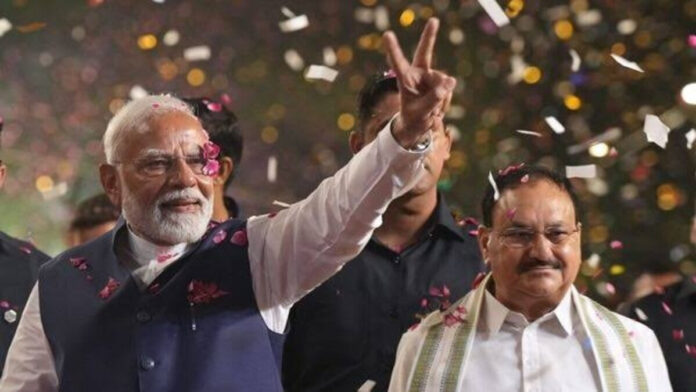
The Indian general election saw Prime Minister Narendra Modi declare victory for his alliance and assert that this was a mandate to go through his agenda despite his party losing seats to an unexpectedly strong opposition that resisted his divisive politics and inconsistent economic track record.
Speaking to an audience at his party’s headquarters on Tuesday, Modi declared, “Today’s victory is the victory of the world’s largest democracy,” adding that Indian voters have “shown immense faith” in both his party and the coalition he leads, the National Democratic Alliance.
In contrast to expectations, the NDA secured 294 seats, which is more than the 272 seats required for a majority, according to official results released by India’s Election Commission on Wednesday.
His Hindu nationalist Bharatiya Janata Party got 240 seats, significantly fewer than the record 303 it won in the 2019 election, but it failed not achieve a majority on its own for the first time since it stormed to power in 2014.
Modi, who had anticipated an overwhelming victory, will now require the backing of other parties in his alliance, which is a devastating setback for the 73-year-old. 370 seats will probably go to Modi’s party and another 30 seats to his supporters, he predicted during his campaign.
He now relies on the backing of important partners, such as the Janata Dal (United), which won 12 seats in eastern Bihar state, and the Telugu Desam Party, which has 16 seats in the southern state of Andhra Pradesh.
“Indian voters can’t be taken for granted,” said the Times of India newspaper in an editorial. “Voters have clearly indicated that jobs and economic aspirations matter. The economic message from the results is that jobs matter.”
The Congress party increased their number of seats from 52 in the 2019 elections to 99. Among its most important partners, the Samajwadi Party stunned the BJP by winning 37 seats in the state of Uttar Pradesh’s north; the All India Trinamool Congress won 29 seats in the state of West Bengal; and the Dravida Munnetra Kazhagam won 22 seats in the state of Tamil Nadu’s south.
The opposition INDIA coalition won a total of 232 seats.
The BJP may now be “heavily dependent on the goodwill of its allies, which makes them critical players who we can expect will extract their pound of flesh, both in terms of policymaking as well as government formation,” said Milan Vaishnav, director of the South Asia Program at the Carnegie Endowment for International Peace.
“At the very least, the result pricks the bubble Prime Minister Modi’s authority. He made this election about himself,” said Pratap Bhanu Mehta, a political commentator. “Today, he is just another politician, cut to size by the people,” he said in an article.
The world’s greatest democratic exercise took place over the course of six weeks, with over 640 million votes cast.
Challengers asserted that they had also achieved a form of success in response to the unexpected decline in the BJP’s support, while the main opposition Congress party declared that Modi had suffered a “moral and political loss” in the election.
“This is public’s victory and a win for democracy,” Congress party President Mallikarjun Kharge told reporters.
Despite the setback, Modi pledged to make good on his election promise to turn India’s economy into the world’s third biggest, from its current fifth place, and not shirk with pushing forward with his agenda.
He said he would advance India’s defense production, boost jobs for youth, raise exports and help farmers, among other things.
“This country will see a new chapter of big decisions. This is Modi’s guarantee,” he said, speaking in the third person.
Many of the Hindu nationalist policies he’s instituted over the last 10 years will also remain locked in place.
Modi’s win was only the second time an Indian leader has retained power for a third term after Jawaharlal Nehru, the country’s first prime minister. Before Modi came to power, India had coalition governments for 30 years.
Congratulations for Modi from leaders of regional countries including neighboring Nepal and Bhutan flowed in, while the White House commended India for its “vibrant democratic process.”
In his 10 years in power, Modi has transformed India’s political landscape, bringing Hindu nationalism, once a fringe ideology in India, into the mainstream while leaving the country deeply divided.
His supporters see him as a self-made, strong leader who has improved India’s standing in the world. His critics and opponents say his Hindu-first politics have bred intolerance while the economy, one of the world’s fastest-growing, has become more unequal.
For Payal, a resident of the northern city of Lucknow who uses only one name, the election was about the economy and India’s vast number of people living in poverty.
“People are suffering, there are no jobs, people are in such a state that their kids are compelled to make and sell tea on the roadside,” Payal said. “This is a big deal for us. If we don’t wake up now, when will we?”
Rahul Gandhi, the main face of the opposition Congress party, said he saw the election numbers as a message from the people.
“The poorest of this country have defended the constitution of India,” he told a news conference.
Modi’s popularity has outstripped that of his party’s during his first two terms in office, and he turned the parliamentary election into one that more resembled a presidential-style campaign, with the BJP relying on the leader’s brand.
“Modi was not just the prime campaigner, but the sole campaigner of this election,” said Yamini Aiyar, a public policy scholar.
Under Modi’s government, critics say India’s democracy has come under increasing strain with strong-arm tactics used to subdue political opponents, squeeze independent media and quash dissent. The government has rejected such accusations and says democracy is flourishing.
Economic discontent has also simmered under Modi. While stock markets have reached record-highs, youth unemployment has soared, with only a small portion of Indians benefitting from the boom.
A confident BJP first centred its campaign on “Modi’s guarantees,” emphasising the welfare and economic accomplishments that, according to the party, have decreased poverty, when votes started in mid-April. “India will become a developed nation by 2047,” Modi declared at rally after rally while leading the charge.
However, as Modi increased his divisive language directed against Muslims, who account for 14% of the population, the campaign became more and more strident, a move intended to energise his core Hindu majority supporters.
In addition to campaigning on problems of inequality, unemployment, and inflation, the opposition INDIA alliance criticised Modi for his Hindu nationalist policies.
“These concerns have struck a chord and created a ripple,” public policy expert Aiyar continued.