


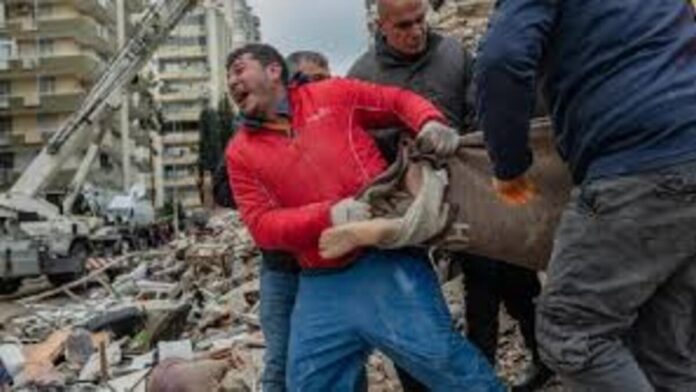
On Tuesday night, rescuers in Turkey and Syria dug with their bare hands through the bitterly cold night in search of survivors among the wreckage of the thousands of buildings that had been destroyed by a series of powerful earthquakes.
Following a series of powerful tremors close to the Turkey-Syria border, the number of confirmed fatalities across the two countries has risen past 4,300. The strongest of these shocks had a magnitude of 7.8.
More than 5,600 buildings, including several multi-story apartment buildings that were packed with sleeping occupants when the first earthquake struck, have been flattened across numerous cities, according to Turkish and Syrian disaster response teams.
Eyewitnesses in the southeast Turkish city of Kahramanmaras struggled to grasp the scope of the catastrophe.
Melisa Salman, a 23-year-old reporter, said, “We believed it to be the end of the world.” “We had never experienced anything like that before,” one person said.
Turkey’s humanitarian organisation AFAD reported on Tuesday that the confirmed death toll had increased to 4,365, with 2,921 of those deaths occurring in Turkey alone.
With up to 20,000 possible fatalities, according to World Health Organization authorities, there are worries that the death toll may continue to increase steadily.
Rescuers searching amid the rubble in Gaziantep, a Turkish city where numerous refugees from Syria’s ten-year civil conflict now reside, screamed, sobbed, and pleaded for protection as another building abruptly collapsed nearby.
The original earthquake’s magnitude was so great that it could be felt as far away as Greenland, and its effects were so severe that they prompted a global response.
Although freezing rain and below-freezing temperatures have hindered the response, dozens of countries, from the Ukraine to New Zealand, have committed to provide assistance.
Rescuers were working through the night to try and extract people from the rubble of a fallen seven-story building in the city of Sanliurfa in southeast Turkey.
The 20-year-old Syrian student Omer El Cuneyd added, “There is a family I know under the rubble.”
“My pal was still answering the phone till 11:00 or noon. She no longer responds, though. She is situated there.”
Fearful locals spent the night on the streets, huddling around fires for warmth despite the subzero outside temperatures.
Because he was too terrified to move, Mustafa Koyuncu piled his wife and their five kids into their car.
According to the 55-year-old, “We can’t go home.” Everyone is terrified.
Near the epicentre of the earthquake, between Kahramanmaras and Gaziantep, large sections of cities lay in ruins as snow began to accumulate.
The first earthquake on Monday occurred at 4:17 a.m. (0117 GMT) near the city of Gaziantep, Turkey, which has a population of around two million, at a depth of roughly 18 kilometres (11 miles).
According to the disaster management organisation, more than 14,000 injuries have so far been reported in Turkey, while at least 3,411 injuries have been reported in Syria.
Authorities said that three significant airports were rendered inoperable, hindering the distribution of life-saving aid.
Major entry roads into the region are blanketed with ice and snow due to a winter snowfall.
Many of the homes, hospitals, and clinics in the earthquake-stricken region of northern Syria have already been damaged by years of conflict and aircraft bombing by Syrian and Russian forces.
Bassam Sabbagh, Syria’s representative to the UN, appears to be ruling out reopening border crossings that would enable supplies to reach areas under the control of rebel groups, indicating that the violence is already influencing the humanitarian response.
Aleppo, Latakia, Hama, and Tartus, where Russia is renting a naval facility, were among the areas where damage was reported by the Syrian health ministry.
Buildings in Aleppo, Syria’s pre-war commercial centre, frequently collapsed due to the deteriorated infrastructure, which had been harmed by a lack of wartime control, even before the tragedy.
As a precaution, officials turned off the natural gas and electricity in the area. They also closed the schools for two weeks.
Concerns regarding severe damage to two of the cities on its list of world heritage—Aleppo in Syria and Diyarbakir in Turkey—were made by the UN organisation for culture, UNESCO.
At least 20 inmates managed to escape from a penitentiary in northwest Syria, where the majority of the inmates were members of the Islamic State group, after a mutiny.
Immediately, condolence messages and assistance offers were issued from the United States, the European Union, and Russia.
President Joe Biden assured Recep Tayyip Erdogan of Turkey that the United States will send “any and all” resources required to aid in the recovery process following a severe earthquake.
Additionally, Ukrainian President Volodymyr Zelensky offered to give Turkey, whose combat drones are assisting Kyiv in fighting the Russian assault, “the required aid.”
Turkey is located in one of the seismically active regions of the planet.
The last 7.8-magnitude earthquake that struck the nation killed 33,000 people in the eastern province of Erzincan in 1939.
A 7.4-magnitude earthquake that struck the Turkish area of Duzce in 1999 resulted in the deaths of over 17,000 people.
Experts have long warned that Istanbul, a 16 million-person megalopolis full of unstable homes, might be completely destroyed by a powerful earthquake.