


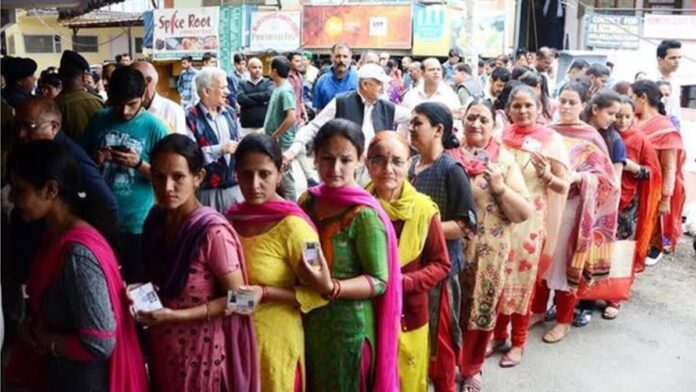
According to the most recent electoral rolls statistics, the number of Assembly constituencies in Karnataka where women voters exceed men has increased to 112 – or 50% of the total 224 seats – from 67 (30%) in 2018.
The number of women voters per 1,000 male voters in the state has increased from 973 to 989 over the past five years, improving the state’s overall gender ratio of electors.
In accordance with information gathered from the electoral records for the Assembly elections on May 10, there are 2.67 crore men and 2.64 crore women voters.
The Mahadevapura seat has the lowest female to male voter ratio (858 to 1,000), whereas Mangalore City South has the highest (1,091 to 1,000).
Overall, 140 seats had more female electors than the 989 average for the state.
According to Karnataka Special Officer for Elections Surya Sen A V, it is important to consider migration trends, the gender ratio of the population, and the government’s effort to “clean the rolls” when analysing the gender ratio of voters.
He claimed that because males migrate to coastal locations, including Mangalore City South, in search of employment, there are more women in the population overall.
Men have been impacted by the “de-duplication” effort the government launched to remove duplicate entries from the electoral registers since they move around more for work and have voter IDs from many addresses, the officer added.
Given the growing participation of women voters in the past two Assembly elections in Karnataka, which has helped to close the turnout gap with men, the increase in the elector gender ratio is significant.
Women used their right to vote at a rate of 70.47% in the 2013 elections, rising to 71.53% in 2018. In contrast to this, men’s participation slightly increased from 72.40% in 2013 to 72.68% in 2018.
Male and female turnout in the 2008 Assembly elections were 66.2% and 63.1%, respectively.
In 112 of the state’s 34 election districts, which are mostly distributed in rural regions, women voters exceed men this election.
These districts are Bagalkot, Bangalore Rural, Belgaum, Bellary, Bijapur, Chamarajnagar, Chikkaballapur, Chikkmagalur, Chitradurga, Dakshina Kannada, Davangere, Dharwad, Gadag, Gulbarga, Hassan, Kodagu, Kolar, Koppal, Mandya, Mysore, Raichur, Ramanagaram, Shimoga, Tumkur, Udupi, Uttara Kannada, Vijayanagara and Yadgir.
The only election districts without such a seat are Bangalore Urban, Bidar, and Haveri as well as BBMP (Central), BBMP (North), and BBMP (South).
108 seats have a gender ratio between 900 and 1,000, while 112 seats have a gender ratio of greater than 1,000. Bangalore South (897), Dasarahalli (877), Bommanahalli (867) and Mahadevapura (858) are the four constituencies where it is below 900.
There were 973 more male voters than female voters overall in 2018, with 2.57 crore male voters and 2.50 crore female voters, respectively. There were 67 Assembly seats where there were more women voters than men. These seats were spread across 24 districts: Bagalkot, Belgaum, Bellary, Chamarajnagar, Chikkaballapur, Chikkmagalur, Chitradurga, Dakshina Kannada, Davangere, Dharwad, Gulbarga, Hassan, Kodagu, Koppal, Mandya, Mysore, Raichur, Ramanagaram, Shimoga, Tumkur, Udupi, Uttara Kannada, Vijayanagara and Yadgir.
Of these 67 seats, the BJP won the most (36) in the 2018 Assembly elections, while Congress bagged 21, JD(S) 9 and BSP 1.
According to the most recent data, the elector gender ratio is lowest (816) among voters aged 18 to 19 and highest (1,225) among those over 80. The gender ratios for the other age groups were 943 for those aged 20 to 29, 1 014 for those aged 30 to 39, 952 for those aged 40 to 49, 1 013 for those aged 50 to 59, 1 021 for those aged 60 to 69, and 1 059 for those aged 70 to 79.
According to the then-chief election commissioner Sushil Chandra, women’s turnout in the 2019 Lok Sabha elections was higher than men’s turnout nationwide by 0.17%, up over the years from -16.71% in 1962.