


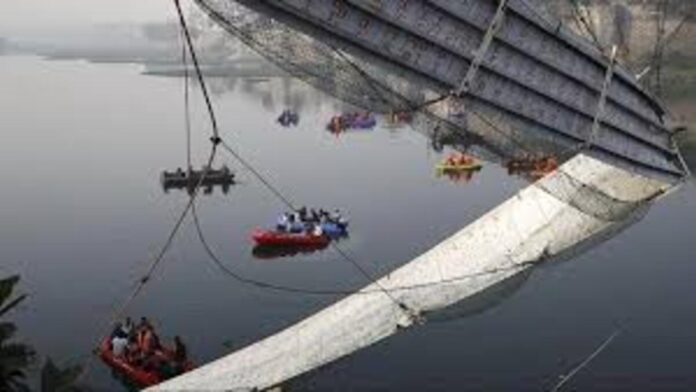
One of the main flaws that caused the collapse of the suspension bridge in Morbi last year, which resulted in the deaths of 135 people, was the welding of old suspenders with new ones, according to the Special Investigation Team (SIT) that the Gujarat government appointed.
The five-member SIT included these conclusions in its “Preliminary Report on Morbi Bridge Disaster,” which was turned in in December 2022. Recent communication of the report by the State Urban Development Department to the Morbi Council.
The suspension bridge over the Machchu River built in the British era was operated and maintained by Ajanta Manufacturing Limited (Oreva Group), which is also accountable for the collapse on October 30, 2017. The SIT had discovered numerous flaws in the bridge’s administration, maintenance, and repairs.
Members of the SIT included an IAS official named Rajkumar Beniwal, an IPS officer named Subhash Trivedi, a secretary and chief engineer from the State Roads and Building Department, as well as a structural engineering professor.
The SIT noted that one of the two main cables of the bridge, constructed over the river Machchhu by the former rulers in 1887, was experiencing corrosion problems, with nearly half of its wires “possibly already broken” even before the cable broke on October 30 in the evening.
The SIT claims that the main cable on the river’s upstream bank broke, causing the tragedy. Seven strands, each made up of seven steel wires, made up each line. According to the SIT report, a total of 49 wires were bundled into seven strands to create this line.
“Of the 49 wires in that cable, 22 were found to be corroded, suggesting that those wires may have already been broken prior to the event. Recently, 27 of the remaining wires failed, according to the SIT’s assessment.
The SIT also discovered that “old suspenders (steel rods) that link the cable with the platform deck were welded with the new suspenders” during the renovation work. As a result, suspenders’ behaviour altered. Single rod suspenders should be used to carry the load in these kinds of bridges.
Notably, the Oreva Group (Ajanta Manufacturing Limited), which had closed the bridge in March 2022 for renovations and opened it on October 26 without any prior approval or inspection, had been given the contract to maintain and operate the bridge by the Morbi Municipality without the approval of the general board.
Nearly 300 people were on the bridge at the time of collapse, which the SIT claims was “far more” than the load-bearing capability of the bridge. However, it stated that laboratory results would confirm the bridge’s real carrying capacity.
The investigation report also noted that adding an aluminium deck in place of individual wooden planks contributed to the fall.
Instead of using flexible wooden boards, the walking framework was constructed from rigid aluminium panels. The number of fatalities might have been fewer if there had been individual wooden planks, as there were (before renovation). Furthermore, no structure or weight test was carried out prior to opening the bridge,” it continued.
According to the SIT, the deck is less flexible and less likely to deform in its own plane because the aluminium honeycomb panels were fixed together tightly with no space between them. The use of aluminium also might have increased the bridge’s overall weight.
The IPC Sections 304 (culpable homicide not amounting to murder), 308 (attempt to commit culpable homicide), 336 (act which endangers human life), 337 (causing harm to any person by performing any rash or negligent act), and 338 (causing grievous hurt by doing rash or negligent act) have already resulted in the arrest of ten suspects, including the MD of the Oreva Group Jaysukh Patel.