


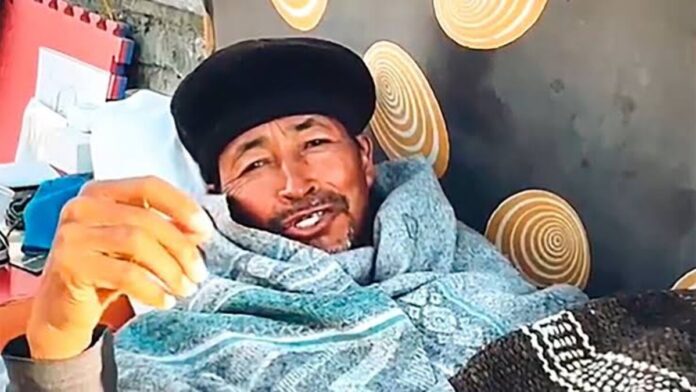
In the lead-up to Sonam Wangchuk’s planned border march, which aims to “highlight the ground realities in Ladakh”—including China’s purported encroachment—the administration of the Union territory has announced that internet speeds will be lowered and prohibitory orders have been issued in the Leh district.
On Sunday, thousands were predicted to participate in the march to the Line of Actual Control, which is a component of the statehood struggle. On March 27, Mr. Wangchuk called for a “Pashmina March” that would follow the model of Mahatma Gandhi’s Dandi March. The day before, he had announced the end of his 21-day fast in support of Ladakh’s statehood and the protection of the rights of the region’s majority tribal population as outlined in the Sixth Schedule of the Constitution.
The innovator, who is leading the protests and is currently fasting for three days, blasted the administration for allegedly trying to put an end to the march and claimed that its peace attempts suddenly sounded “dangerous.”
On Friday, the government issued two distinct instructions. In an order, the Additional Director General of Police, Ladakh, stated that “there is every apprehension about misuse of mobile data and public WiFi facilities by anti-social elements and miscreants to incite and provoke general public through various means of social media,” citing input from the police and intelligence agencies.
The order said “it is absolutely necessary to reduce” mobile data services up to 2G, “thereby suspending the mobile data of 3G, 4G, 5G & Public Wi-fi facilities 5G temporarily”. It stated that the order would apply in Leh city and a radius of 10 km around it from 6 pm on Saturday to 6 pm on Sunday.
The District Magistrate of Leh issued another notice, this time enforcing prohibitory orders in accordance with Section 144 of the Criminal Procedure Code (CrPC).
The order places limitations on a number of activities, including public meetings, loudspeakers put on vehicles without licence, and parades, marches, and rallies.
Mr. Wangchuk asserted earlier on Friday that the administration was acting to intimidate participants in the agitation and coerce them into signing bonds, even though a nonviolent march was scheduled. Furthermore, he asserted that because Ladakh is a Union region, the administration was receiving instructions from New Delhi.
In a video posted on X, he said in Hindi, “Maybe the administration has been asked to maintain peace at any cost. Fasts have been on for 31 days and no incidents have happened. And yet, people are being taken to police stations and being given warnings of action if there is a breach of peace. I fear that this could actually lead to a breach of peace. I think there’s some misunderstanding, so I won’t say much right now.”
The activist had declared that thousands of people will march to the border area in the eastern part of the Union territory, joining shepherds in the process. He asserted that China has appropriated more than 4,000 square kilometres of territory.
“Like Mahatma Gandhi carried out the Dandi March, we are going for a march to Changthang. We will go with shepherds and they will show us up to what point our grazing land was and where it stands today” he had said.
Mr Wangchuk also asked the administration to keep prisons ready as a jail bharo andolan (movement for voluntarily courting arrest) would be launched after the march.
“If the need arises, we will be starting a non-cooperation movement in Ladakh in the coming weeks and months. The administration here will be paralysed,” he said.
After the former state of Jammu and Kashmir was split in August 2019 and deprived of its statehood and special status under Article 370 of the Constitution, Ladakh was established as a distinct Union territory.
Ladakhis sensed a political vacuum within a year. Leaders of the predominantly Muslim Kargil and Buddhist Leh joined forces under the banners of the Kargil Democratic Alliance and the Apex Body of Leh to demand statehood for Ladakh and its inclusion in the Sixth Schedule of the Constitution, sparking massive protests and hunger strikes earlier this year.
Despite the Centre forming a high-level committee to investigate the Ladakh people’s requests, several meetings with protestor representatives resulted in no agreement being reached. On March 4, leaders from Ladakh met Home Minister Amit Shah and said he had refused to accept their demands. Mr Wangchuk began his 21-day fast in Leh two days later.