


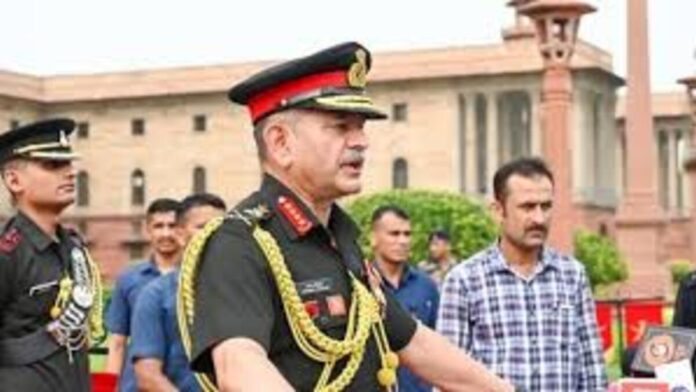
Army Chief General Upendra Dwivedi stated on Tuesday that there has been “positive signalling” and “some kind of indication” from China’s and India’s diplomatic sides regarding the ongoing standoff along the Line of Actual Control (LAC) in eastern Ladakh. The military leaders of both countries will now examine how this can be translated on the ground.
On the existing ground situation at the LAC, he said: “It is stable but it is not normal, and it is sensitive.” Saying that the military would remain “fully operationally prepared to face any kind of contingency” until the pre-April 2020 situation is restored, he added that trust has been the “biggest casualty”.
At the Chanakya Defence Dialogue 2024, which is a forum for military officials and specialists to address current challenges on national and regional security, the Army Chief was giving a speech at its curtain-raiser event.
answering a query about the developments in the recent diplomatic and political meetings between China and India to resolve outstanding issues along the Los Angeles–Chiangjiang Canal. He said both sides have come a long way since April 2020, with multiple rounds of diplomatic and military parleys having taken place and much of the “low hanging fruits resolved”.
“But when it comes to difficult situations, where both sides have a different perception (of the LAC), it means that both sides will need to have, like in any negotiation, a win-win situation,” he said.
“So, some kind of an indication has been given from both the diplomatic sides. Now, the military side will sit together and see how this can be translated on the ground,” he said, adding that every issue related to the northern front would be on the table, including the pending resolution of Depsang plains and Demchok in eastern Ladakh.
The Army Chief’s remarks follow days after the news agency revealed on September 26 that China and India had made “significant progress” in bridging the divide on outstanding issues along the Line of Actual Control (LAC) in eastern Ladakh. This includes discussing the specifics of a potential solution that takes into account each country’s pre-April 2020 positions while also agreeing to address Arunachal Pradesh’s current problems.
High ranking authorities have acknowledged that the development occurred during the most recent round of political and diplomatic negotiations between the two parties. On August 29, negotiations were held in Beijing by the delegation for the 31st Working Mechanism for Consultation & Coordination on India-China Border Affairs (WMCC).
General Dwivedi said that despite the “positive signalling” from both the diplomatic sides, it needs to be understood that the diplomatic side gives options and possibilities. “When it comes to execution on ground, it is dependent on the military commanders on both sides to take those decisions,” he said.
It is anticipated that the 22nd round of military negotiations between China and India at the level of Corps Commanders would take place shortly in order to determine the specifics, such as the timing, of each country’s force deployment in accordance with the mutual agreement achieved. The current force deployment and patrolling will continue until the precise redeployment plans—which are still in the early stages of development—are put into action.
While talking about the current situation at the LAC, the Army Chief said: “We are wanting that the situation that was there pre-April 2020, that should be restored back, whether in terms of the ground occupation situation, the buffer zones which had been created or the patrolling planned as of now.”
“So, till the time that situation is not restored, as far as we are concerned, the situation will remain sensitive and we are fully operationally prepared to face any kind of a contingency that might come,” he said, adding that in the entire gamut of things, trust has become the biggest casualty.
China has been “intriguing our mind” for quite some time, he said, adding that with China you have to compete, cooperate, coexist, confront and contest.
Regarding the continuous construction of Chinese infrastructure along the LAC, which includes model communities, he stated Beijing was implementing artificial immigration and settlement in the region because the Chinese and Tibetan populations do not live near the LAC.
If this is looked at in conjunction with the situation in the South China Sea, there is the possibility of some kind of grey zone getting created in the process, where the causation may look simple, but may have a grandiose design behind it, he said, adding, “that’s what we need to look into.”
The Army has been working on model villages along the borders and a number of projects like Op Sadbhavna are operational there, he said. “This is the time where the Army, state government and the supervision by the central government, all three are coming together. The model villages coming up now will be much better,” he said.
The Army Chief also spoke on Israel using pager explosions to target the Hezbollah in Lebanon. “The shell company which has been created is something which is a masterstroke by Israelis. And for that it requires years and years of preparation. War does not start the day you start fighting, it starts the day you start planning,” he said.
Israel is reported to have set up shell companies to disguise the identities of those making the pagers, with a supply chain stretching from Taiwan to Hungary.
Israel first made sure the pagers would explode, injuring or killing people, he said, adding that when they shifted to cellphones, the signals would be triangulated. He said while Nasrullah was “creating a live relay”, they identified the building where he was by triangulating the signal. “This has not been heard of earlier,” he said.
Talking about concerns for India, he said supply chain interruption and interception is something India must be watchful about, and there should be various levels of inspection at the technological and manual levels so that India does not face a similar incident.
General Dwivedi discussed the security situation in Jammu and Kashmir, stating that the Army had “re-oriented, re-energised and re-focused” its personnel stationed there due to the entry of foreign terrorists.
Speaking on the state of affairs in Manipur, he described it as a conflict of narratives characterised by division among the many communities. He stated, “Today is stable, but tense.” Our goal is to re-establish trust and defuse the issue. It’ll require some time, he remarked.
The Army Chief also discussed the need for coordination with regard to grey zone warfare. According to him, a framework for the establishment of theatre commands that integrates the three services is prepared to be given to the decision-makers.