


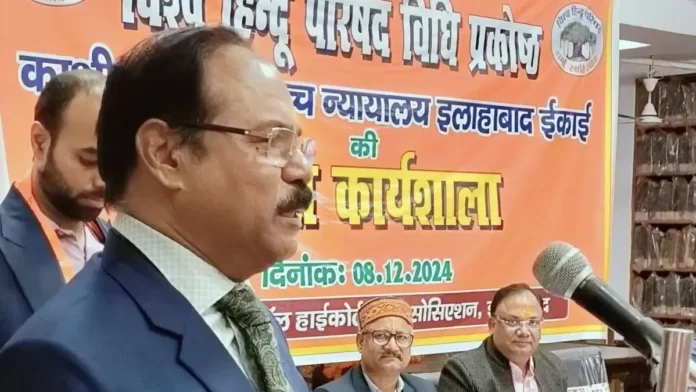
An impeachment notice against Justice Shekhar Yadav of the Allahabad High Court, stemming from his controversial remarks at a Vishwa Hindu Parishad (VHP) event last year, has crossed the crucial threshold required to move forward in the Rajya Sabha. Sources have confirmed that at least 50 Members of Parliament (MPs) from the Upper House have signed the notice—meeting the minimum number required by law to initiate the impeachment process.
The notice was originally submitted in December by 54 MPs, mostly from the opposition, following Justice Yadav’s speech where he made several contentious statements about India being governed by the majority community and commenting on the Uniform Civil Code and certain Muslim personal laws. His remarks sparked widespread debate and outrage, prompting the MPs to seek his removal.
However, the process has encountered some procedural hurdles. The Rajya Sabha secretariat reached out to all 54 signatories multiple times via email and phone, asking them to verify their signatures because of some inconsistencies found in the original notice. For example, one MP’s signature appeared twice, reducing the total count from 55 to 54 signatures.
So far, 44 MPs have officially confirmed their signatures after being contacted. Of the remaining 10, six MPs have said they did sign the notice but haven’t yet completed the formal verification, while four MPs were either unreachable or occupied with other commitments such as election duties.
Some senior opposition leaders, including Kapil Sibal and P. Chidambaram, have stated that although they signed the notice, they were not contacted properly by the secretariat to verify their signatures. Sibal expressed frustration and suggested that if the verification process cannot be properly completed, the notice should be rejected so the matter can be taken up in the Supreme Court.
The secretariat has also asked MPs to bring authenticated copies of the evidence they attached to the impeachment notice, including news articles, legal reports, and videos, which they believe demonstrate the judge’s “outrageous” remarks and justify the move for impeachment.
Meanwhile, the Rajya Sabha Chairman, Jagdeep Dhankhar, who is also the Vice-President of India, has neither accepted nor rejected the notice, citing that the Judges (Inquiry) Act, 1968, does not specify a strict timeframe for deciding on such motions. He emphasized that the authority to handle impeachment notices constitutionally rests with him, and eventually with the Parliament and the President.
This impeachment notice follows Justice Yadav’s speech at the VHP event on December 8 last year. In that speech, he boldly claimed that India should be governed according to the majority population and criticized certain Muslim personal laws, especially around the rights of wives under Islamic law. He argued that practices like untouchability and sati were addressed long ago in Hindu society, and questioned why polygamy without consent should be allowed in Muslim communities.
The controversy stirred strong reactions across political lines, and the MPs’ impeachment motion seeks to hold Justice Yadav accountable for what they see as a breach of judicial impartiality and constitutional values.
As the verification of signatures continues and the legal process unfolds, all eyes remain on how this significant parliamentary process will shape up in the coming months, and what it might mean for judicial independence and political accountability in India.