


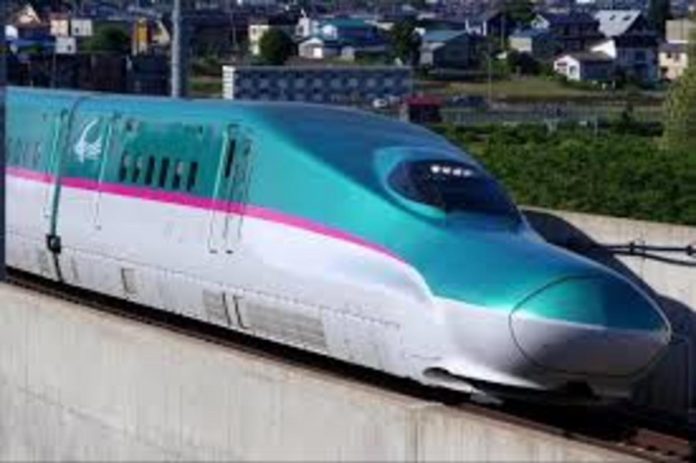
India’s first high-speed Bullet Train is all set to hit the railway tracks by 2026, Union Railways Minister Ashwini Vaishnaw made the big announcement.
The Mumbai-Ahmedabad High-speed Rail Corridor Project is as of now really taking shape. She said if there is any chance of delay, then it can go up to 2027, but not beyond that.
National High-Speed Rail Corporation Limited (NHSRCL) has worked together with Japan Railway Track Consultant Company (JRTC) to bring the bullet train to India. In any case, the Japanese organization is hanging tight for the land obtaining drive to arrive at finishing without a hitch.
According to Railway Minister, the corridor among Mumbai and Ahmedabad requires the obtaining of land, which appears to have stuck in Maharashtra. While Gujarat has retained generally 97% of the complete land required, Mumbai is yet to permission for some parts of land.
The National High-Speed Rail Corporation Limited (NHSRCL) signed a MoU to plan the high velocity rail route with the help of the Japan Railway Track Consultant Company (JRTC).
The Bullet Train will cover a distance of 508 kilometers at a speed of 320kmph. It will have 12 stops of 165 seconds each.
The train will take 2 minutes less in 3 hours to reach Mumbai from Ahmedabad if it stops at each of the 12 stations.
The 12 stations include Sabarmati, Ahmedabad, Anand, Vadodara, Bharuch, Surat, Bilimora, Vapi, Boisar, Virar, Thane and Mumbai.
If the train stops only at four stations — Ahmedabad, Vadodara, Surat and Mumbai, it will cover the distance in just two hours and 7 minutes.
As of now, about 119 pillars have been cast and these numbers are likely extend for another 50 kilometres in the next six months.
Total of 35 bullet trains will start when Indian Railways start it’s operations, with 70 trips each day. The trains will increase to 105 by 2050.
The venture needs around 825 hectares of land, of which 92% will be on the elevated route, 6% will be in tunnels and 2% will be on grounds.
A 21 km long tunnel will bs built between Boisar and Bandra Kurla Complex in Mumbai, 7 km of which will be under sea.
In the starting, the train will have 10 coached with a seating capacity of 750 passengers, which will later be increased to 16 coaches.