


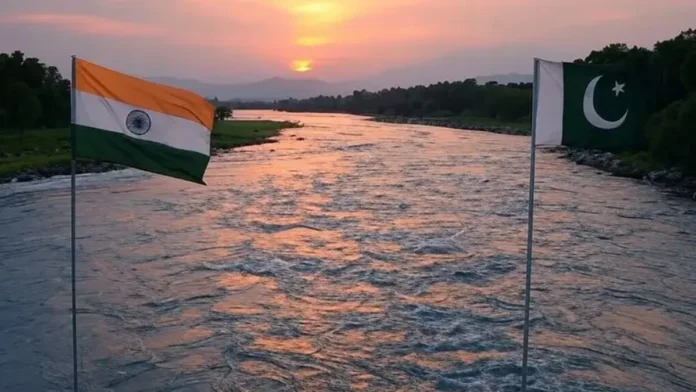
The nation’s highest national security decision-making body, the Cabinet Committee on Security, or CCS, has taken harsh and punitive action against Pakistan due to “cross-border linkages” that have come to light during the investigation into the heinous terror attack in Pahalgam, Jammu and Kashmir, which claimed the lives of 26 people, including one foreign national.
On September 19, 1960, the Indus Waters Treaty was signed. India and Pakistan signed the deal, which was mediated by the World Bank. Although that treaty survived the 1965, 1971, and 1999 conflicts between India and Pakistan, it is currently under indefinite suspension.
Announcing the measure, Foreign Secretary Vikram Misri said, “In the briefing to the CCS, the cross-border linkages of the terrorist attack were brought out. It was noted that this attack came in the wake of the successful holding of elections in the Union Territory and its steady progress towards economic growth and development.” He went on to say that “Recognising the seriousness of this terrorist attack, the CCS decided upon the following measures:”
With immediate effect, the 1960 Indus Waters Treaty will be suspended unless Pakistan firmly and permanently renounces its endorsement of transnational terrorism. With immediate effect, the border between Attari and Wagah will be blocked by the Integrated Check Post. Before May 1, 2025, those who have crossed across with legitimate endorsements may do so again.
Under the SAARC Visa Exemption Scheme (SVES), Pakistani people will not be able to enter India. Any SVES visas issued in the past to Pakistani nationals are declared revoked. Every Pakistani national with an SVES visa in India has 48 hours to depart the country. The Pakistani High Commission in New Delhi has designated its naval and air advisers, who are defense or military officers, Persona Non Grata. They can depart India in a week. India’s own aviation and navy advisors will be leaving the Indian High Commission in Islamabad. These posts in the respective High Commissions are deemed annulled with immediate effect. Five support staff of the service advisers will also be withdrawn from both High Commissions immediately.
The overall strength of the High Commissions will be brought down to 30 from the present 55 through further reductions, to be effected by 01 May 2025.
In addition to these, Mr Misri also announced that “The CCS reviewed the overall security situation and directed all forces to maintain high vigil. It resolved that the perpetrators of the attack will be brought to justice and their sponsors held to account. As with the recent extradition of Tahawwur Rana, India will be unrelenting in the pursuit of those who have committed acts of terror, or conspired to make them possible.”
Reacting to the decision to suspend the Indus treaty, Water Resources Minister CR Paatil said, “In the past too, an ultimatum was given to them (Pakistan) by Prime Minister Narendra Modi and Home Minister Amit Shah. Action was taken in the past, and this time too the perpetrators shall not be spared. As for the suspension of the Indus Waters Treaty, it has been a very good decision taken by the Cabinet.”
According to the 1960 Indus Waters Treaty, which governs six joint rivers, Pakistan has the right to use the waters of the Indus, Jhelum, and Chenab, while India has full control over the waters of the Ravi, Beas, and Sutlej.
One of the few long-standing agreements between India and Pakistan, the Indus Waters Treaty continues to be the most effective illustration of collaboration between the two nuclear-armed neighbors. Following the terror attack on paramilitary men in Pulwama in 2019, Prime Minister Narendra Modi allegedly warned the Cabinet Committee on Security that “blood and water can’t flow together.” but decided not to put it into effect at the moment.
However, the top decision-making body in India has chosen to suspend the water-sharing deal in response to this despicable action by the terrorist organization The Resistance Front, based in Pakistan, which has claimed responsibility for the deaths of 26 tourists in Kashmir. An offshoot of the outlawed Lashkar-e-Taiba is the Resistance Front.
A water supply problem will be a matter of grave concern for Pakistan. Experts have cautioned in recent years that Pakistan is already on the verge of a severe water scarcity brought on by a number of reasons, including inadequate water management, population expansion, and climate change. When India was considering suspending the Indus treaty, Pakistan had previously stated that an attempt to withdraw from the pact would be viewed in Islamabad as “an act of war.”
The extent of New Delhi’s annoyance with Islamabad over Pakistan’s use of terrorism as a “instrument of state policy” is demonstrated by India’s decision to halt the water-sharing agreement.
SAARC Visa Exemption Scheme is shortened to SVEC. Certain types of dignitaries are given special travel documents under the program. They are excluded from the requirement for visas and other travel permits because of this unique certificate. Dignitaries, higher court judges, lawmakers, senior officials, businesspeople, journalists, and athletes are among the 24 categories of people that are now on the list.