


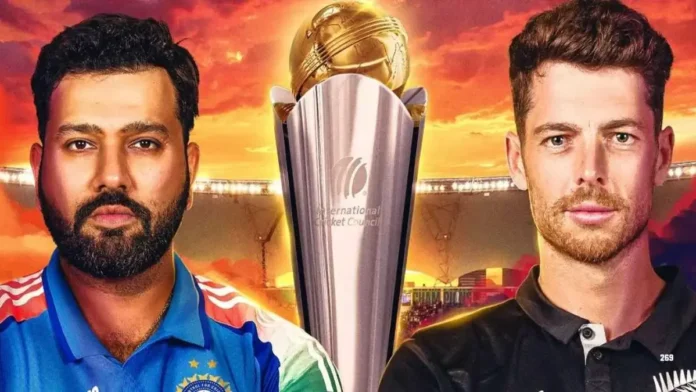
The cricket world was very different when India and New Zealand last faced off in an ICC white-ball competition final. Cricket in the Middle East only meant Sharjah, T20 was still three years away, and the competition was called ICC Knockouts. One-Day Internationals dominated the sport’s scene.
A quarter of a century later, the same teams—now regarded as among of the world’s top all-around teams—will compete for fame and $2.24 million in prize money on Sunday at the Champions Trophy summit match at the Dubai International Cricket Stadium. In the run-up to the match, the two teams seemed the most well-organized of the eight, with squads of comparable depth. And their success thus far is not entirely unexpected.
Both have a talismanic player at No. 3 who can anchor an innings while keeping a high strike-rate, openers who can provide explosive starts, and really talented bats lower down who can change gears with ease. With their tall quicks who can move the ball about and create uncomfortable bounce, New Zealand bowlers have a marginally superior pace attack. Despite not being of the highest caliber, the spin-bowling department has enough of options thanks to the resourceful Mitchell Santner.
A left-arm wrist-spinner, two left-arm orthodox spinners, and a right-arm spinner whose identity has long been a mystery make up India’s diverse collection of wicket-taking tweakers. As the tournament favorites, Rohit Sharma’s team has lived up to the hype, going undefeated to the final. With almost every player who has set foot in the pitch contributing significantly, the squad’s achievement to date has been the pinnacle of teamwork.
Despite not scoring many goals, captain Rohit has led from the front with his unwaveringly aggressive PowerPlay style. Virat Kohli has been instrumental in winning matches against Australia (in the semi-final) and Pakistan, making difficult chases seem simple. In a high-pressure match, the middle- and lower-order players’ skill in rescuing the team from precarious situations may prove useful.
The spinners have dominated the middle overs due to Dubai’s slow surfaces, and it has been difficult to score boundaries without taking significant risks. India, the world’s top-ranked team, has defeated every opponent in this match. The final will take place on the same field as the match between India and Pakistan two weeks ago. That day, the former chased down 242, and slower bowlers should benefit from the surface’s predicted behavior.
With the necessary all-around balance, New Zealand is the only side capable of stopping India. However, the Kiwis lost to India here a week ago when Varun Chakaravarthy scythed through the line-up, and will now need their batters to find a way to put pressure on the Men in Blue’s spin quartet.
For senior pros, the word “R” is frequently used at the conclusion of a major tournament. Steve Smith of Australia announced his retirement from ODIs following Tuesday’s semifinal defeat. Given that Rohit would be over 40 by the time of the 2027 World Cup, there has been some discussion about whether he could give up his ODI boots after Sunday. If so, leading India to their second consecutive white-ball ICC championship following the T20 World Cup last year might be the ideal way to say goodbye to one of the best ODI players of this generation.