


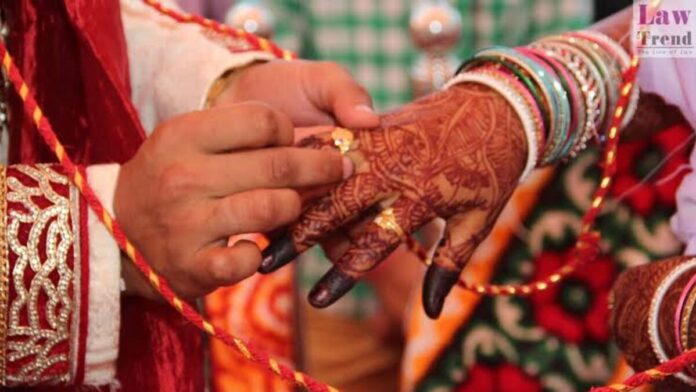
The Supreme Court has noted that a Hindu marriage is not an occasion for “song and dance,” “wining and dining,” or a business deal, and that the Hindu Marriage Act does not recognise a Hindu marriage in the “absence of a valid ceremony.”
Hindu marriages are sacraments and “samskaras,” and as such, they should be recognised as highly valued institutions in Indian society, according to a bench of Justices BV Nagarathna and Augustine George Masih.
In its recent order passed in the matter of two trained commercial pilots, who sought a divorce decree without performing a valid Hindu marriage ceremony, the bench urged young men and women to “think deeply about the institution of marriage even before they enter upon it and as to how sacred the said institution is, in Indian society”.
“A marriage is not an event for ‘song and dance’ and ‘wining and dining’ or an occasion to demand and exchange dowry and gifts by undue pressure leading to possible initiation of criminal proceedings thereafter. A marriage is not a commercial transaction. It is a solemn foundational event celebrated so as to establish a relationship between a man and a woman who acquire the status of a husband and wife for an evolving family in future which is a basic unit of Indian society,” the bench said.
Declaring that a Hindu marriage is sacred because it unites two people in a lifelong, equal, consenting, dignified, and healthy union, the bench further stated that Hindu marriages promote procreation, strengthen the family unit, and fortify the spirit of fraternity across diverse communities.
“We deprecate the practice of young men and women seeking to acquire the status of being a husband and a wife to each other and therefore purportedly being married, in the absence of a valid marriage ceremony under the provisions of the (Hindu Marriage) Act such as in the instant case where the marriage between the parties was to take place later,” the bench said.
The bench stated in its April 19 ruling that a Hindu marriage will not be recognised as such if it is not carried out in line with the relevant customs or rituals, such as “saptapadi,” which involves the bride and groom walking together before a sacred fire for seven steps.
“We further observe that a Hindu marriage is a sacrament and has a sacred character. In the context of saptapadi in a Hindu marriage, according to Rig Veda, after completing the seventh step (saptapadi) the bridegroom says to his bride, ‘With seven steps we have become friends (sakha). May I attain to friendship with thee; may I not be separated from thy friendship’. A wife is considered to be half of oneself (ardhangini) but to be accepted with an identity of her own and to be a co-equal partner in the marriage,” it said.
The bench observed that marriage is the basis for a new family and that Hindu law views it as a sacrament or “samskara.” It also stated that there is no such thing as a “better-half” in a marriage; rather, the spouses are equal halves in a marriage. pointing out that, as centuries have passed and the Act has been passed, the only kind of marriage that is recognised by the law is monogamy.
“The (Hindu Marriage) Act has categorically discarded polyandry and polygamy and all other such types of relationships. The intent of the Parliament is also that there should be only one form of marriage having varied rites and customs and rituals,” it noted.
The bench stated that the Act had codified the law pertaining to Hindu marriage after it went into effect on May 18, 1955. This law covers not only Hindus as such, but also Lingayats, Brahmos, Aryasamajists, Buddhists, Jains, and Sikhs who can enter into a legally binding Hindu marriage falling under the broad definition of Hindu.
“Unless the parties have undergone such ceremony, there would be no Hindu marriage according to Section 7 of the (Hindu Marriage) Act and a mere issuance of a certificate by an entity in the absence of the requisite ceremonies having been performed, would neither confirm any marital status to the parties nor establish a marriage under Hindu law,” it said.
The highest court emphasised that while marriage registration aids in proving the facts of a marriage in a contentious situation, “the registration would not confer legitimacy to the marriage” if there hasn’t been a marriage in line with Section 7 of the Hindu Marriage Act.
It noted that under the Special Marriage Act, 1954, a man and a woman can acquire the status of being a husband and a wife as per the provisions of the said Act. “The Special Marriage Act, 1954 is not restricted to Hindus. Any man and woman irrespective of their race, caste or creed can acquire the status of being a husband and a wife under the provisions of the Special Marriage Act, 1954 but under the provisions of the Act (Hindu Marriage Act, 1955), there should not only be compliance of the conditions as prescribed under Section 5 of the said Act but also the couple must solemnise a marriage in accordance with Section 7 of the Act,” it said.
The top court, using its plenary powers under Article 142 of the Constitution, ruled that the divorced couple was not legally married and that the marriage certificate that the Hindu Marriage Act had given them in the absence of a legal ceremony was void.
In addition, it cancelled the divorce process and the dowry lawsuit brought against the spouse and his relatives.