


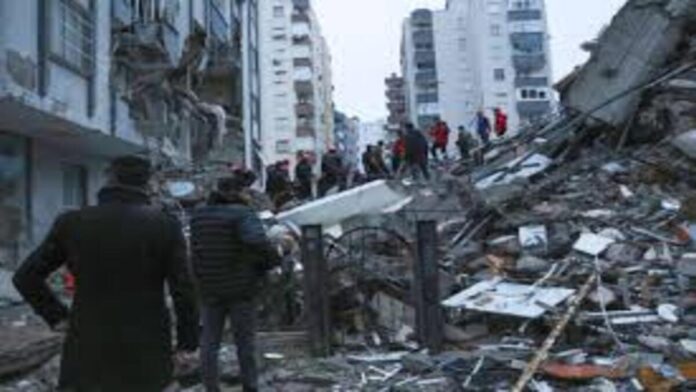
After receiving criticism for his government’s response to the devastating earthquake that has killed over 15,000 people in Turkey and Syria, Turkish President Recep Tayyip Erdogan acknowledged “shortcomings” on Wednesday.
The disaster’s massive scope, which resulted in the destruction of thousands of structures and the entrapment of an undetermined number of people, has overwhelmed relief efforts that were already impeded by the bitter cold.
The survivors were left to search for food and shelter and, in some cases, watch helplessly as their loved ones cried out for aid before going silent under the rubble.
“In the rubble lie my nephew, my sister-in-law, and my sister-in-sister. law’s There is no sign of life, and they are stuck beneath the wreckage “explained Hatay, Turkey kindergarten teacher Semire Coban.
“They are out of our reach. They are not responding to our attempts to communicate with them. We are awaiting assistance. It’s been 48 hours already, “She spoke.
Even though the death toll is still rising three days after the 7.8 magnitude earthquake, which is already one of the deadliest this century, searchers kept finding survivors amid the rubble.
Erdogan visited one of the hardest-hit areas, the earthquake epicentre Kahramanmaras, as online criticism of the reaction grew.
“Undoubtedly, there are problems. The circumstances are plain to discern. It is impossible to prepare for a catastrophe like this, “added he.
Journalists and the web monitoring company NetBlocks reported that Twitter was not functioning on Turkish mobile networks.
As the search effort gets closer to the 72-hour mark, which catastrophe experts regard to be the most likely time to save lives, the window for rescuers to find survivors is getting smaller.
However, on Wednesday, rescuers in the severely damaged Turkish province of Hatay, where entire villages have been levelled, managed to dig youngsters out from under a collapsed structure.
Alperen Cetinkaya, a rescuer, recalled, “All of a sudden we heard voices and due to the excavator… right away we heard the voices of three persons at the same time.”
The prospects of getting individuals out of here alive are very strong, he continued, “We are expecting more of them.”
Officials and medical personnel reported that 15,383 people had perished worldwide as a result of Monday’s 7.8-magnitude earthquake, including 12,391 in Turkey and at least 2,992 in Syria. Experts anticipate that this number will continue to grow substantially.
The EU is organising a donors’ summit in Brussels in March to mobilise global assistance for Syria and Turkey.
Ursula von der Leyen, the head of the EU, wrote on Twitter, “We are now racing against the clock to save lives together.”
When a catastrophe like this affects a people, no one should be left alone, said von der Leyen.
Survivors claimed that they felt alone in dealing with the tragedy due to the extent of the devastation and the lack of assistance reaching some locations.
“Even the standing structures suffered significant damage. Currently, there are more people below the debris than there are above it “In the Syrian village of Jindayris, which is held by rebels, a local by the name of Hassan remarked.
“Each building that has collapsed has between 400 and 500 people trapped underneath it, and only 10 individuals are attempting to rescue them. Moreover, no machinery exists “Added he.
In a “race against time,” the White Helmets, who are in charge of operations to rescue those trapped under rubble in areas of Syria controlled by rebels, have requested assistance from abroad.
Since the earthquake, they have been working to extricate survivors from under the rubble of hundreds of destroyed buildings in war-torn regions of northwest Syria that are still out of government control.
Leading UN official demanded that aid be made more easily accessible to rebel-held areas in the northwest, saying that supplies of supplies will soon run out.
El-Mostafa Benlamlih, the UN’s resident Syria coordinator, told AFP in an interview, “Put politics aside and let us perform our humanitarian work.”
The EU’s commissioner for crisis management, Janez Lenarcic, noted that the topic of aid to Syria is a complex one and that the sanctioned government in Damascus made an official appeal to the EU for assistance.
Hospitals had already been devastated, the economy had already collapsed, and there had been electricity, fuel, and water shortages due to a decade of civil conflict and aerial bombardment by Syria and Russia.
Lenarcic said that the European Commission is “encouraging” EU members to fulfil Syria’s request for food and medical supplies while also keeping an eye out to make sure that any assistance “is not misdirected” by President Bashar al-administration. Assad’s
The United States, China, and the Gulf States are among the dozens of countries that have committed their support, and rescue teams and relief supplies have already arrived.
Following the significant earthquake that occurred in Turkey on Monday near the Syrian border, the European Union moved quickly to send emergency workers to the nation.
However, due to EU sanctions against Assad’s government since 2011 as a result of its deadly crackdown on protesters that descended into a civil war, it first only provided Syria with modest aid.
One of the seismically active regions on the planet is at the Turkish-Syrian border.
Turkey hasn’t had an earthquake of this size since 33,000 people died in the eastern region of Erzincan in 1939.
More than 17,000 people perished in a 7.4 magnitude earthquake in 1999.