


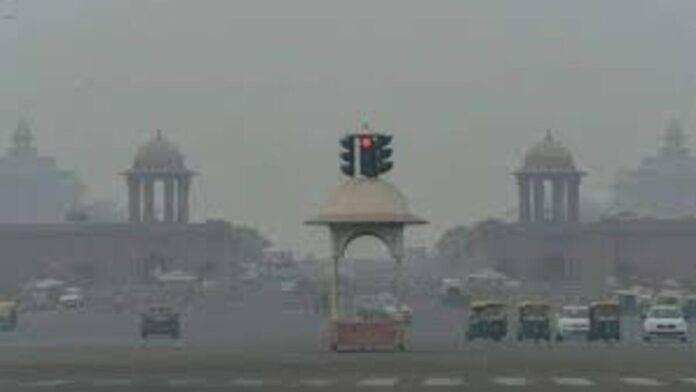
Even though Delhi’s air quality marginally improved on Tuesday, it is anticipated to stay in the “Very poor” or upper end of “Poor” range until Wednesday (November 9). Data from the System of Air Quality and Weather Forecasting and Research (SAFAR) show that the nation’s capital was still gasping for air at an AQI of 321.
According to the SAFAR forecast, the air quality will continue to be at the upper end of the Poor category due to weak upper level wind flow, a decrease in local emissions, and moderate pollution dispersion that will dilute near surface pollution.
The state government of Delhi announced the reopening of schools on November 9 and lifted a few other restrictions, such as limits on the entry of trucks and small goods carrier vehicles into the nation’s capital, as the air quality in Delhi improved. The ban on private construction and demolition, according to Delhi Environment Minister Gopal Rai, will remain in place.
However, it has been requested that schools stop including outdoor activities in their schedules. Additionally, the state government reinstated the work-from-home policy in its offices.
The “Paryavaran Bus Service,” which consists of 500 privately owned CNG buses, will continue to function, according to the environment minister.
In light of Delhi’s poor air quality, the Centre’s air quality panel has requested that pollution control boards in Delhi-NCR ensure the deployment of anti-smog guns at construction and demolition sites, according to a formal statement released on Monday. Other actions, such as the use of wind brokers, dust barrier screens, covering building materials and their debris, and safe disposal of construction waste, including transportation in covered vehicles at these locations, have also been advised by the Commission for Air Quality Management.
The panel acknowledged that these locations consistently and significantly contribute to air pollution in Delhi-NCR.
“A minimum of one anti-smog cannon is required for a construction site with a total area of between 5,000 and 10,000 square metres. For an area between 10,000 and 15,000 square metres, two anti-smog weapons.
“At least three anti-smog cannons are required for building areas between 15,001 and 20,000 square metres. According to the CAQM statement, at least four anti-smog cannons should be used if there are more than 20,000 square metres of work going on.
According to officials, the entry of trucks into the national capital will be permitted, but the movement of BS III petrol and BS IV diesel cars will continue to be prohibited until November 13. The Delhi government decided on Monday to lift the order that required 50% of its personnel to work from home and to resume elementary courses starting on November 9 as the city’s air quality improved.
One of the main causes of air pollution in north India is burning of snags. Punjab experienced 2,487 occurrences of stubble burning on Monday, bringing the state’s total number of farm fire incidents to 30,000. The cumulative number of agricultural fire cases from September 15 to November 7 increased to 32,486 as a result of new crop residue burning occurrences, according to statistics from the Punjab Remote Sensing Centre in Ludhiana.
With an extremely low AQI of 354, Noida fell behind Delhi in terms of progress. Gurugram, meanwhile, registered an overall AQI of 326, which still has to be improved.