


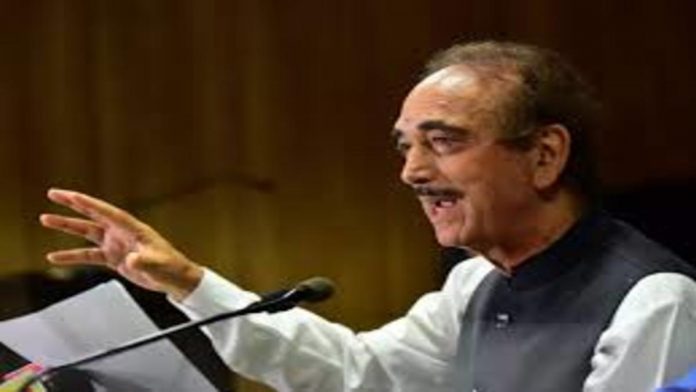
Ghulam Nabi Azad, a veteran Congress leader with a 45-year public career, has always avoided controversy. But, given the Congress’s declining electoral returns, Azad believes it is past time for him to speak up.
With a veiled reference to Rahul Gandhi and Priyanka Gandhi Vadra, Azad discussed party democracy, or the lack thereof, in the current Congress leadership.
“The current Congress generation is not receptive to new ideas. If some senior members give one, it is perceived as a crime or rebellion,” Azad said, adding that senior leaders’ advise should not be viewed as a challenge or offensive.
Azad was one of 23 senior leaders, called G23 or Group of 23 by the media, who wrote to Congress president Sonia Gandhi last year, urging her to reflect on the party’s back-to-back electoral defeats and devise a new strategy. The group also emphasised the importance of democratising party processes, beginning with organisational polls to choose a president.
On Sunday, Azad remarked that while leaders have an excellent relationship with Sonia Gandhi, the younger generation is not interested in listening to seniors.
When asked about his recent remark that the Congress will not win 300 seats in the Lok Sabha elections, Azad clarified that he was referring to the only occasion the party got 300+ seats under Indira Gandhi and the time it crossed 250 with Narasimha Rao as prime minister. “We’ve gained significantly fewer seats in the last few decades. It is for everyone to see,” he said.
“It hurts when our advice is not heeded. We give suggestions for the overall improvement of the party. None of us wants any posts in the party. All we want is that the performance of the party should improve,” he said. “This is a time when the ruling party is strong and the Opposition is weak. A weak Opposition benefits the ruling party.”
Talking about pending organisational elections, Azad said the party initially used to hold elections every year for the president’s post, which was later extended to two and five years. “And these days, there is no time limit… Congress leadership is not as flexible as it was. It was known internationally,” he said candidly.
Asked if the Congress is on decline, Azad said, “It is for everyone to see.”
“I am a staunch Congressi… The party needs to introspect, work together, devise strategies and pull itself up and be a force to reckon with.”
Azad even admitted to infighting in the Jammu and Kashmir unit of the Congress, but sought to distance himself from it. “I have nothing to do with it. My rallies have no connection with this,” he said, flanked by former state ministers and legislators from his party.
The Jammu and Kashmir unit has been in disarray, with 20 senior and middle-ranking leaders resigning from their posts in the party. The politicians had sent Sonia Gandhi a letter last month, requesting that she reform the local Congress organisation and dismiss current president Ghulam Ahmad Mir.
When asked if the leaders want him to lead the J&K unit, Azad stated that he has no plans to do so. Many Congress politicians close to Mir, on the other hand, are keeping a tight eye on Azad’s sudden political activity in Jammu and Kashmir. “Who is he batting for, and what are his motivations?” a leader asked on the condition of anonymity.
The former chief minister recently staged protests in Chenab, Pir Panjal, and Kashmir, advocating for human rights and employment while criticising the administration for firing employees. “Who is deadwood?” says the narrator. Local employees or the existing regime? “These are unusual times,” he declared at the rally, drawing applause from the crowd.
Former chief minister and National Conference leader Omar Abdullah had criticised Azad, saying that some leaders had “given up” on their position on special status for Jammu and Kashmir, without identifying the Congress veteran.
Azad has urged the Centre to restore J&K’s sovereignty, hold elections, and reinstate the Assembly in several of his rallies so that welfare programmes can be delivered to the people. Azad, on the other hand, has mostly avoided discussing the reinstatement of special status, claiming that the court or the current government at the Centre can do so.
“Let’s be practical. The special articles were taken away by the current dictatorship, and they will not be returned. When asked if he had reconciled to the idea that Article 370 is done and dusted, he told reporters, “The courts can adjudicate on it, but there hasn’t been any hearing for many months.”