


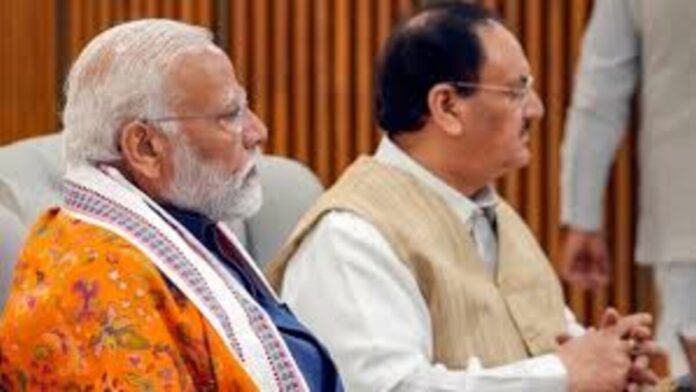
After lengthy overnight meetings in Delhi, including one led by the Prime Minister at his Delhi residence that started at 11 p.m. on Thursday and ended at 4 a.m. on Friday, the BJP is expected to release a first list of candidates—more than 100 names—for the 2024 Lok Sabha election later today. This list will include notable candidates like Prime Minister Narendra Modi and Home Minister Amit Shah.
According to sources who spoke with news agency, the BJP’s approach to seeking a third term centres on obtaining input on the performance of current members of parliament, including but not limited to conversations with local activists and voters, as well as a tactical rearrangement to remove any anti-incumbency sentiment.
Additionally, according to sources last night, the party plans to announce the names of a number of its candidates—apart from those allied with the National Democratic Alliance—well in advance of poll dates in order to increase pressure on its principal rival, the Congress-led INDIA bloc, which has yet to finalise seat-share agreements.
Candidates for the Hindi heartland states of Uttarakhand, Madhya Pradesh, Chhattisgarh, Rajasthan, and Gujarat—home state of Mr. Modi—would be the main focus of the Thursday night–Friday early meeting. The southern states of Telangana, where the BJP was crushed by the Congress last year, and Kerala, where it has historically been a nonentity, were also under scrutiny.
Other state decisions, pertaining to Tamil Nadu, Punjab, and Andhra Pradesh, have been postponed while alliance negotiations with local parties are ongoing. The BJP must decide between the Telugu Desam Party-Jana Sena combination and the incumbent YSR Congress Party in the former state, while it hopes to rebuild relations with the Akali Dal and the AIADMK in the latter two.
In any event, the list is not due until noon, but it is expected that Mr. Modi will return to defend his seat in Varanasi, Uttar Pradesh, a BJP stronghold since 1991 (with the exception of a 2004 Congress victory).
In 2014 and 2019, he claimed resounding victories here, winning by 3.7 lakh votes in the first election and by 4.8 lakh in the second. There were rumours that the INDIA group, led by Congresswoman Priyanka Gandhi Vadra, may contest the prime minister’s hat-trick bid.
Nitish Kumar, the chief minister of Bihar and a founding member of INDIA’s Janata Dal, was another potential contender, but he has now re-aligned with the BJP, ruling that one out.
Although Ms Gandhi Vadra’s (long-awaited) political debut has not yet been confirmed—there was speculation that she may run in the 2019 election as well—the resignation of Congress matriarch Sonia Gandhi from the party’s Raebareli bastion has created an opportunity for the party to potentially have a flawless introduction.
Meanwhile, Gandhinagar, Gujarat, could be the home ground of Amit Shah.
Since 1989, the BJP has occupied the seat, which has allowed luminaries like LK Advani and former prime minister Atal Bihari Vajpayee to serve in the Lok Sabha. In 2019, Mr. Shah emerged victorious from this constituency, defeating Chaturainh Chavda of the Congress by a margin of more than 5.5 lakh votes.
Defence Minister Rajnath Singh and Aviation Minister Jyotiraditya Scindia, two of Amit Shah’s cabinet colleagues, could run from Lucknow and Guna-Shivpuri in Madhya Pradesh, respectively.
The capital of Uttar Pradesh, like Gandhinagar, is a BJP bastion.
This constituency was held by Mr. Vajpayee from 1991 to 2004. Rajnath Singh took over in 2014, unseating Rita Bahugana Joshi of the Congress and Poonam Sinha of the Samajwadi Party.
Given that Madhya Pradesh is the home stronghold of Mr. Scindia’s family, his anticipated seat there is regarded as a given. From the inaugural election in 1952, the Scindia royal family has won this seat fourteen times.
Between 2002 (a by-election was required due to the death of his father, Madhavrao Scindia) and 2014, Jyotiraditya Scindia held this seat; however, at that time, he was a Congress member. He gave up the seat following his contentious cross-over and was nominated to a state Rajya Sabha seat in its place.
Krishna Pal Yadav of the BJP won the seat in 2019.
Other candidates who might be included in the initial list include former chief minister Sarbananda Sonowal, who was elected in 2004 (as an Asom Gana Parishad candidate) from Dibrugarh in Assam.
Chief Minister Himanta Biswa Sarma announced on Thursday that the BJP would run for 11 seats around Assam, leaving three for its partners, the Asom Gana Parishad and United People’s Party Liberal.
Expect some shocks as well. According to rumours, fiery Bhopal MP Pragya Thakur has decided not to run for reelection, despite the seat being handed to former chief minister of Madhya Pradesh Shivraj Singh Chouhan.
Mr. Chouhan reportedly declined the seat and stated he wishes to run from his home district of Vidisha. Mr. Chouhan was fired following the BJP’s victory in the Assembly election last year, despite his social initiatives, especially the “Laadli Behna” scheme, which guaranteed the party would retain the state.
From 1991 until 2004, the seat was a BJP stronghold and the former chief minister won it five times. The saffron party has controlled Vidisha since 1989.
Talks on giving up six seats in politically significant Uttar Pradesh, which sends 80 MPs to the Lok Sabha, for local allies like the Apna Dal and Jayant Chaudhary’s Rashtriya Lok Dal—which the BJP apparently won over from INDIA despite their January agreement—are also thought to have taken place during the meeting.
By March 10, the goal is to have at least half of its candidates named. The party followed suit in 2019 by announcing 164 candidates on March 21, many weeks ahead of scheduled announcements.