


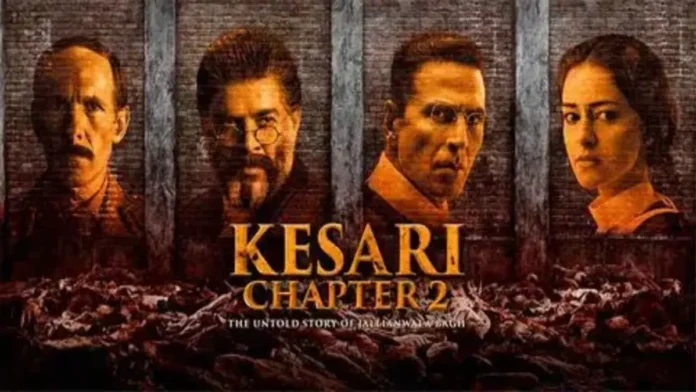
When C Shankaran Nair sued the British Empire in 1919 for committing a genocide at Jallianwala Bagh on April 13 of that year, “Kesari Chapter 2” forces you to demand the apology India should have received in court.
Indians excel in a variety of fields. However, ‘Kesari Chapter 2’ demonstrates that we are also invincible when it comes to using the appropriate medium—cinema—to ask the right questions of the right people. Since the Jallianwala Bagh atrocity turned our Baisakhi scarlet, it may have taken us 106 years to wake up, but that is irrelevant. The bigger question is – why have the British not apologised to India yet? The film’s tone is unmistakable: it does not depict India’s ongoing grief for the thousands of people—including women and children—who were killed that day in an Amritsar park. The audience is being stirred by this clear call.
As a real-life nationalist, Akshay Kumar takes over the movie; however, this time, he wears a black coat rather than a uniform. He portrays Sir C Shankaran Nair, a member of the British Viceroy Council and the “best Indian barrister.” Nair was recently knighted. Nair secretly protested the Rowlatt Act, which allowed the police the authority to arrest anyone without a justification, by suing General Reginald Dyer for ordering an open fire on innocent people.
You don’t have to spend much time figuring out who is who and what the dispute is. It opens with the horrific massacre scenes and depicts the cries of the victims’ families and survivors. ‘Kesari Chapter 2’, which is based on the novel ‘The Case That Shook The Empire’ by Raghu and Pushpa Palat, never begs for your pity as readers. And that’s arguably the movie’s best feature. You are not crying, you are fuming.
You never forget that you are watching a full-fledged commercial Bollywood film since there is enough drama and memorable monologues. You don’t mind any of it, though. The movie initially arouses your emotions before igniting a fire that won’t go out, demonstrating its sincere goal.
Akshay stands out in probably one of the most memorable performances of his career. But, this is not something he hasn’t done before. He understands the pulse of the nation, and knows how to fan the flames. His monologues are delivered not like a hero, but like any common man being attacked, questioned, manipulated and forced to retaliate. This is Akshay’s world. He rules it, owns it and understands it better than anyone else in the industry.
‘Kesari Chapter 2’ doesn’t entirely rely on a chest-thumping, bulldozed sense of patriotism to win the audience’s hearts – there’s that hard-to-forget use of the F-word in an open court, and an elaborate dialogue explaining Hindu-Muslim unity. It unapologetically adds a bit of creative swag, and lets you be a part of the drama.
The film’s first half remains crisp and largely sets the stage for what’s coming in the second half, which is every bit more engaging and heroic. You’ve got to be clear about one thing while watching ‘Kesari Chapter 2’. That it is not a documentary. It is a full-blown commercial entertainer, though well-intentioned and a thought-provoking one.
If Akshay is the class monitor in ‘Kesari 2’, Ananya Panday is that backbencher who would rather read silently and sharpen her wits than participate in a dramatic debate using borrowed knowledge. She has somehow cracked the art of first finding, and then balancing her skills as an actor. Panday is contained, not in a hurry to shine the brightest, to take the limelight, to overpower her co-stars or the story, in any way.
R Madhavan, as the defence lawyer, a half-Indian, half-British Neville McKiney, adds to the film’s intense mood with his clean performance, while others also follow suit. Only one thing matters – the fight for the truth – and all of those associated with the film, including the artistes and the makers, never let the audience feel otherwise.
Technically and emotionally, “Kesari Chapter 2” is not a masterpiece. Its heart is in the right place, though. Telling the audience that we have grieved in silence long enough and that it is time to demand a long-overdue apology is the premise. The performances, the conversations, who has outperformed whom, and who could have performed better are all only formalities and technicalities. That’s also another thing about ‘Kesari 2’. It makes everything else look futile and small in front of its spirit.
‘Teri Mitti’ by B Praak is used in the backdrop by the creators to create a more engaging experience. However, they typically continue to show the drama in its true form. The massacre’s horror is so unadulterated, genuine, and heartbreaking that it breaks your heart without the need for any kind of cinematic flourish.
“Kesari Chapter 2” might have been a movie about the genocide’s aftermath, how it affected people’s lives, and the tale of sacrifice and retaliation. However, it tells the tale of a man who was well-versed in the British Empire and who defied authority. It was’shrinking’, he realised, but it was time for it to fall apart in its own deterioration. He smelt the coffee when he woke up, and he didn’t sleep again until he revealed the empire to be a weak, oppressive, and hollow entity that couldn’t fight the swelling wave of Indian nationalism.
India’s letter to the Crown, known as “Kesari Chapter 2,” is in which every citizen folds their hands, meekly, with fire in their eyes and a bleeding heart beneath the weight of history, demanding—not asking—a simple “sorry.” Children, families, the younger audience, and everyone who was born in free India should all watch this film because it demonstrates that even though we gained freedom in 1947, the struggle for justice and honour is still ongoing 106 years later.