


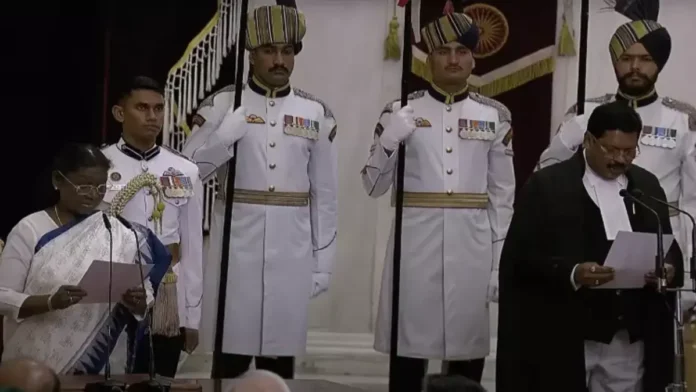
At Rashtrapati Bhavan on Wednesday, President Droupadi Murmu administered the oath of office to Justice Bhushan Ramkrishna Gavai, who became India’s 52nd Chief Justice. The first Buddhist Chief Justice of India is Justice Gavai. In Hindi, he took the oath of office, promising to diligently carry out his duties and respect the Constitution.
In addition to shaking hands with Prime Minister Narendra Modi, Vice-President Jagdeep Dhankar, Law Minister Arjun Ram Meghwal, Home Minister Amit Shah, and other dignitaries and family members seated in the front row, including his immediate predecessor, Justice Sanjiv Khanna, Chief Justice Gavai folded his hands in acknowledgement of the applause. The Indian Chief Justice put his hands on his mother’s feet. Additionally, Mr. Modi was observed approaching the mother of the Chief Justice to welcome her. The ceremony concluded with the rendering of the National Anthem.
The ceremony was attended by both active and retired Supreme Court and High Court judges. Justice Augustine George Masih would remain on the CJI’s bench.
To discuss the future, explain his vision, and solicit comments, the Chief Justice is likely to convene a conference of all justices. Although the court would be partially operational with at least three Benches hearing cases at a time, it is only ten days away from its traditional summer break. The term of Chief Justice Gavai is more than six months, ending on November 23, 2025. On May 24, 2019, he was promoted from the Bombay High Court to the Supreme Court.
Born on November 24, 1960 at Amravati, Justice Gavai joined the Bar on March 16, 1985. The father of Justice Gavai, Ramakrishna Suryabhan Gavai, popularly referred to as “Dadasaheb,” was a well-known Dalit politician and former governor of Bihar. During his tenure, Chief Justice Gavai—who is renowned for being a fearless, resolute, and outspoken judge—may hold significant hearings in the challenges to the Places of Worship Act and the Waqf (Amendment) Act of 2025.
As a Supreme Court justice, he participated in numerous significant rulings, including as the upholding of the Constitution’s Article 370 abrogation and the invalidation of the electoral bonds program. He served on a Constitution Bench that ruled that states might give Scheduled Castes included on the Presidential List a higher status in public jobs and education by subclassifying them.
The right to personal liberty had been strengthened by Justice Gavai’s ruling in the Manish Sisodia bail case. He was the leader of the bench that had decided to free Perarivalan, a prisoner in the Rajiv Gandhi murder case.
From 1987 to 1990, he practiced law on his own at the Bombay High Court. He mostly appeared before the Bombay High Court’s Nagpur Bench after 1990. He worked as a constitutional and administrative lawyer and served as a standing counsel for Amravati University, Nagpur Municipal Corporation, and Amravati Municipal Corporation. In 2003, he was promoted to Additional Judge of the Bombay High Court, and in November 2005, he was made a Permanent Judge.