


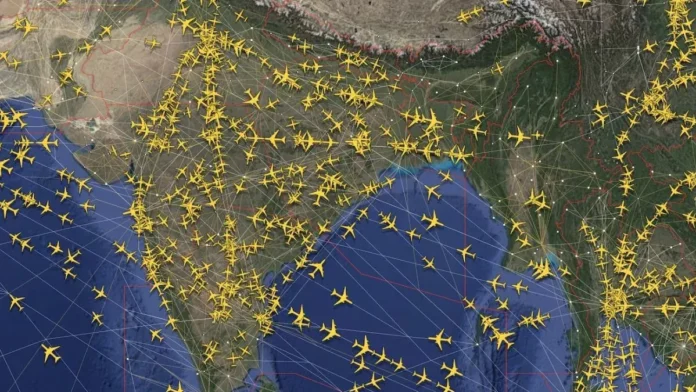
Over 800 flights per week are expected to be impacted by longer flight durations, higher fuel consumption, and a few additional crew and flight schedule complications as a result of Pakistan’s airspace closure to Indian airlines starting Thursday evening. These factors would raise operating expenses. With Indian Airlines’ flights from North India to West Asia, the Caucasus, Europe, the UK, and the eastern region of North America moving from their usual routes to longer ones, the initial impact is already apparent. Depending on the distance and the destination, the journey can take anywhere from 15 minutes to several hours.
The Indian carriers are in the process of modifying their timetables to account for the prohibition on entering Pakistani airspace. On Friday, IndiGo announced the suspension of its daily flights from Delhi to Almaty and Tashkent in Central Asia from April 27 and April 28 until “at least” May 7.
The airline said that both of the Central Asian locations are now beyond of its current fleet’s operational range due to Pakistan’s airspace limitations and the lack of viable rerouting options. IndiGo further stated that 50 of its foreign routes might be impacted by the shutdown of Pakistani airspace, perhaps necessitating changes to its timetable.
International flights to locations in the west of the country are operated by all of the main Indian airlines, and many of these flights frequently pass over Pakistan. Whereas IndiGo offers flights to West Asia, Turkey, the Caucasus, and Central Asia, Air India offers flights to West Asia, Europe, the UK, and North America. West Asian destinations are served by international flights operated by Air India Express, Akasa Air, and SpiceJet.
According to data from Cirium, an aviation analytics company, currently there are almost 400 weekly westward international departures from North Indian airports—Delhi, Amritsar, Jaipur, and Lucknow—that were routinely flying over Pakistan. Given that all these flights have return legs, the total number of affected flights goes up to around 800 from these airports. Of these, around 640 flights are from or to India’s largest airport—Delhi’s Indira Gandhi International airport—which is likely to be the most affected due to the move by Pakistan. Additionally, a handful of ultra-long-haul flights from other Indian cities like Mumbai are also getting impacted as their flight paths used to go through the Pakistani airspace.
In fact, flight tracking data shows that some of Air India’s ultra-long-haul flights to and from North America had to take technical halts—planned stops for refueling or crew change—at European airports like Copenhagen and Vienna on Friday, breaking the journey of the otherwise non-stop flights. These included the airline’s Delhi-Washington and Delhi-New York flights, both of which took a stopover in Vienna, and its Delhi-Chicago, Delhi-Toronto, Delhi-Newark, Mumbai-New York, and Vancouver-Delhi flights, which took a halt in Copenhagen. The airline had announced on Thursday that some of its international flights “will take an alternative extended route” in view of the airspace closure by Pakistan.
Some of Air India’s flights to North America frequently experienced technical halts midway when Pakistan blocked its airspace for an extended period of time, the last time being in 2019 after the Indian Air Force’s Balakot bombings. Air India has so far not commented on whether such halts on the ultra-long-haul flights will now be a routine occurrence.
Airlines are still in the early stages of developing their schedules to adapt to this new reality. Industry sources claim that although it is too soon to determine the full impact, airlines’ expenses would inevitably increase, potentially resulting in increased passenger fares. Additionally, because Pakistani airspace is still open to foreign airlines, they will have a time and cost edge over Indian airlines.
Due to all of this, Indian airlines are being forced to change their itineraries, and they may even decide to stop flying to some locations where it might not be profitable or feasible to run flights that avoid Pakistani airspace, such as IndiGo’s trips to Almaty and Tashkent.
In order to give passengers clarity and schedule stability, airline insiders claim that flight schedules are now being worked on and that the carriers may soon announce adjustments to their networks and schedules. The probable financial impact of Pakistan’s action has not yet been addressed by Indian carriers, but over the coming days, a more complete picture of the impact—both operational and financial—is probably going to become apparent.
Due to increased fuel costs and operational challenges brought on by the lengthier routes that many of their flights had to take, Indian airlines are believed to have lost almost Rs 700 crore when Pakistan blocked its airspace for more than four months in 2019. Since it ran more international flights heading west than any other airline at the time, Air India was the most severely impacted Indian carrier. Additionally, it was and is the only Indian airline that flies to North America and Europe on long-haul and ultra-long-haul routes.
Since then, other Indian airlines, especially IndiGo, have also extended their international networks to include a wider range of locations that their current fleets, which primarily consist of narrow-body aircraft, can serve. IndiGo is the only Indian airline that currently flies to destinations in Central Asia, the Caucasus, and Turkey.