


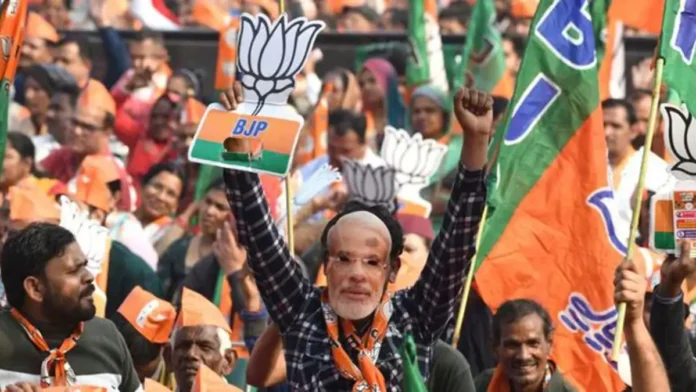
Voter exit polls indicate that Indian Prime Minister Narendra Modi’s party is on track to win the Delhi state elections, ending a 27-year drought. According to estimates, the Bharatiya Janata party (BJP) is expected to retake the Delhi assembly and put an end to the reformist Aam Aadmi party’s (AAP) nearly ten-year dominance in the national capital region.
The pro-Hindu BJP party won 43 seats in a composite “poll of polls,” while the AAP came in second with 26. In a state that had always been a bastion for the secular Congress, Rahul Gandhi’s party was predicted to secure just one seat. However, the AAP maintained that the exit polls were inaccurate, and some individual surveys indicated a far closer race. “Exit polls have never been right about the AAP. Every time, the AAP has stormed to power with a massive mandate, and this time will be no different,” AAP spokesperson Priyanka Kakkar said. In 2020, the AAP won 62 of the 70 assembly seats with the BJP capturing the remaining eight.
The anti-establishment party and its leader, Arvind Kejriwal, an activist whose anti-corruption campaign propelled him to power in Delhi in 2015 and who has been working to expand the party’s reach across the country, would suffer a severe blow if the AAP were to lose. When he launched the party in 2012, Kejriwal framed it as a fight for the aam aadmi, or average person, and pledged to improve everything from water and education to health and power.
Modi has been as harsh on Kejriwal as he has been on him, with Kejriwal’s party emblem being a broom. Prior to the Delhi election, the prime minister spoke at numerous rallies as part of a vigorous campaign against the AAP. Following a lackluster showing in the general elections held in May 2024, where it failed to secure an absolute majority in parliament, the BJP’s predicted victory would serve as further motivation for the party. Together with coalition allies, it established a government.
The BJP’s fortunes may now be clearly improving after winning in the states of Maharashtra and Haryana following the national elections. On Saturday, the official results are due. All three parties actively courted voters throughout the campaign by promising freebies, ranging from cash incentives to free power and water.
The successful public welfare programs that garnered widespread support served as the foundation for the AAP’s governing style. Additionally, the AAP positioned itself as a “squeaky clean” political substitute for the Congress and BJP. However, corruption charges that resulted in the lengthy jail sentences of Kejriwal, the chief minister, and his two closest ministers rocked its second term.
The AAP was accused of receiving payments under a now-scrapped excise scheme as part of an alleged booze fraud, which led to the arrests. Alcohol companies allegedly provided payments to AAP politicians, according to India’s central government inquiry authorities. The AAP said the BJP was pursuing a political grudge and disputed the accusations. However, the accusations and the building of an extravagant chief minister’s mansion that the BJP called the Sheeshmahal, or Palace of Mirrors, damaged the party’s reputation with voters.