


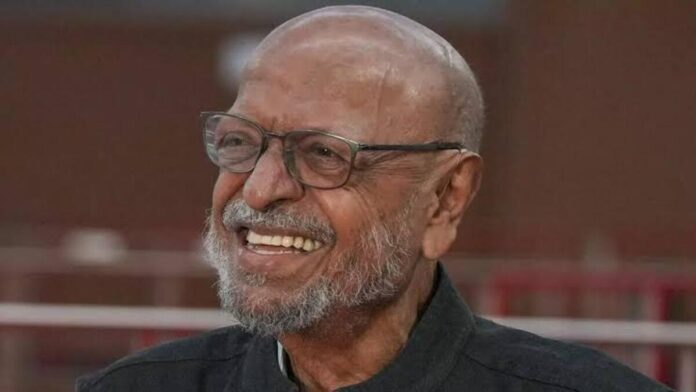
After a protracted illness, veteran filmmaker Shyam Benegal, one of the most significant forerunners of Indian parallel cinema, died at the age of 90. The renowned filmmaker, who modestly marked his 90th birthday on December 15, left behind a significant legacy that revolutionised Indian cinema. Benegal has made an unparalleled contribution to cinema, and both fans and creators are still motivated by his work. Shyam Benegal was born in Hyderabad on December 14, 1934, and had a keen interest in the social and political issues of his day before he entered the film industry. He was the driving force behind India’s parallel film movement, which emerged outside of mainstream Bollywood in the 1970s and 1980s. Characters from under-represented groups in society were included in his films, which were strongly labelled as realistic and social commentary.
Benegal’s first film, Ankur (1973), was released prior to his entry into Bollywood. The movie’s theme was rustic exploitation. It received praise from critics and at the box office. His subsequent works, including Nishant (1975), Manthan (1976), and Bhumika (1977), are lip-synced masterpieces of storytelling that profoundly and deeply address difficult social concerns. The lives of regular individuals in unusual situations were frequently the focus of the filmmaker’s work. While Manthan, supported by the National Dairy Development Board, raised awareness of rural empowerment and farmers’ struggles, Nishant concentrated on social injustice in a rural community. A Marathi actress’s biography, Bhumika, brought attention to the difficulties women encounter in a male-dominated field. As seen by Mandi (1983), which parodied the exploitation of women in society, and Junoon (1978), a period drama set against the backdrop of the 1857 Indian Rebellion, Benegal’s flexibility also extended to his treatment of historical and biographical stories.
Benegal was a significant player in Indian television in addition to his films. Based on Jawaharlal Nehru’s Discovery of India, his 1988 television series Bharat Ek Khoj is regarded as one of the best in India and helps a new generation understand the history of the nation.
In reality, Benegal was a lifelong teacher and mentor who influenced the careers of numerous filmmakers in addition to serving as Chairman of the Film and Television Institute of India (FTII) twice. His influence on Indian cinema goes well beyond his directorial career; he raised a number of filmmakers who have carried on his tradition.
Benegal has won numerous accolades over his career, including 18 National Film Awards, a Filmfare Award, and the coveted Dadasaheb Phalke Award in 2005—India’s highest film distinction. Hard-hitting societal issues, realisations, and concerns were frequently portrayed in his films. He made extensive use of the medium to discuss topics like class battles, gender inequality, and the conflicts that post-independence India experienced. His television efforts, Yatra and Samvidhaan, brought his historical and political narrative to the public’s attention without the help of any noteworthy feature films or big-screen productions.
Benegal has remained a modest and inward guy throughout his life. All of these have been minimised and comprehended simply rather than frantically, even in the midst of a highly successful accomplishment. His definition has consistently been craft-based rather than award-based during this time. As is, a potent vehicle for societal change: will be regarded as a filmmaker who defied expectations, told untold tales, and permanently altered the craft of storytelling.