


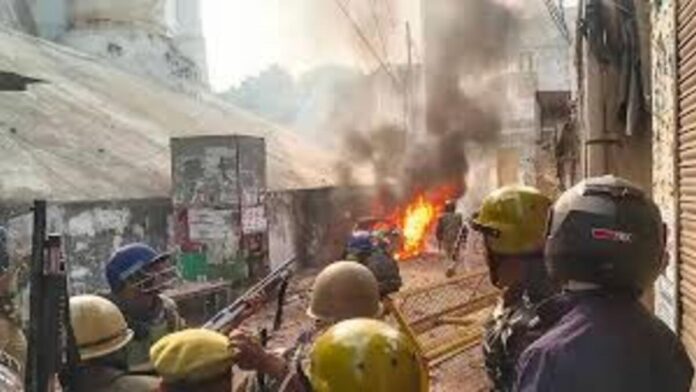
After four people were killed in riots over the Sunday assessment of a mosque in Sambhal, Uttar Pradesh, schools were closed and internet services were suspended.
Violent altercations between the villagers and the police during a court-ordered inspection of the Shahi Jama Masjid, which dates back to the Mughal era, caused chaos in Sambhal on Sunday morning. Due to allegations that it was constructed on the location of a Hindu temple, the mosque is at the focus of a heated legal dispute.
In addition, the demonstrators flung stones and lit some cars on fire towards the police, who used batons and tear gas to scatter the crowd. Approximately 20 police officers were also hurt in the confusion. It is considered critical when a policeman sustains a head injury.
According to an official, 21 people—including two women—have been taken into custody and an investigation has been started. Those suspected of being involved in the assault will be charged under the strict National Security Act (NSA).
“The reason for the death of two of them is clear — bullet wounds from countrymade pistols. The reason for the death of the third person is not clear, but it will be after the post-mortem examination,” District Magistrate Rajender Pensiya was quoted as saying by the news agency.
The district government announced a holiday for all students up to Class 12 on November 25 and blocked internet access in Sambhal tehsil for 24 hours.
Additionally, until November 30, officials have prohibited any outsider, social group, or public official from accessing Sambhal without permission.
Since the Jama Masjid was surveyed last Tuesday on the orders of a local court after a petition alleging that a Harihar temple stood there, Sambhal has been tense. According to the administrators, the survey was scheduled for Sunday morning in order to avoid interfering with the afternoon prayers that are typically done, as it could not be finished on Tuesday. A lawyer for the Hindu side claimed that the temple that once stood at the site was demolished by Mughal Emperor Babur in 1529.
Critics see the poll as a provocation that breaches the sanctity of religious sites as guaranteed by the Places of Worship Act, 1991, while supporters contend that it is an essential step in revealing historical realities.
Officials carried out the survey as scheduled in spite of the violence. As directed by the court, the survey team carried out a thorough inspection of the site, backed by photos and videography, according to advocate Vishnu Shankar Jain, a petitioner in the case. The deadline for submitting the survey report is November 29.
Mr. Jain and his father, Hari Shankar Jain, have previously defended Hindus in numerous issues involving houses of worship, such as the conflict between the Gyanvapi Mosque in Varanasi and the Kanish Vishwanath temple.
Akhilesh Yadav, the leader of the Samajwadi Party (SP), stated that the Supreme Court ought to “immediately” take notice of the “conspiracy to spread tension in the name of survey.”
“A case of disturbing peace and harmony should be registered against those who took sloganeers with them with the aim of disturbing social harmony and the Bar Association should also take disciplinary and punitive action against them. There was no hope from the UP government and administration, nor is there any now,” he posted in Hindi on X, formerly Twitter.
Ajay Rai, the head of the Uttar Pradesh Congress, claimed that under the administration of Chief Minister Yogi Adityanath, violent occurrences were “increasing day by day” in the state.
However, the BJP retaliated by stating that anybody who disagree with court orders ought to pursue legal action.
“Nobody has any right to break the law. If a court has passed an order, it will be implemented. The judicial process is available for those who want the order amended,” party spokesperson Nalin Kohli said.