


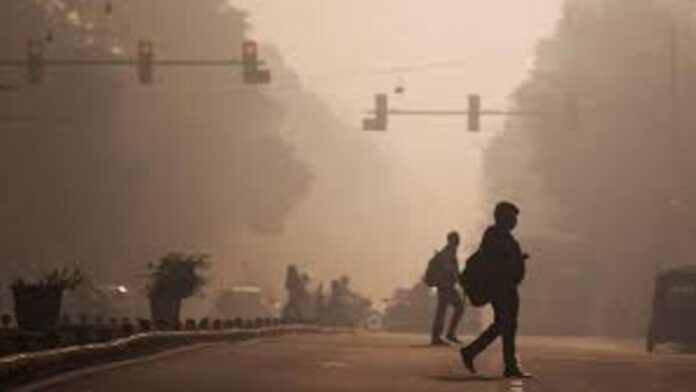
People disobeyed a ban on firecrackers on Thursday night, generating significant noise pollution and lowering visibility. As a result, residents in Delhi, Noida, Gurugram, and other parts of the national capital region woke up to a covering of hazardous smoke the morning after Diwali. However, as wind speeds increased later in the afternoon, the AQI slightly improved. On Friday night, Diwali, the air quality index (AQI) in a number of Haryana locations was rated as “poor” or “very poor.”
The Central Pollution Control Board (CPCB) reported that around 11 a.m. on November 1, the air quality in Delhi’s Anand Vihar was in the “very poor” category, with an AQI of 385.
On Thursday evening, the AQI in Anand Vihar fell into the “severe” category as PM2.5 levels skyrocketed, posing a threat to respiratory health. Numerous locations in Punjab and the Chandigarh Union Territory had air quality indices in the “poor” range.
According to the CPCB, the AQI was 376 in Gurugram, Haryana, 326 in Jind, and 210 in Charkhi Dadri as of Friday at 11 a.m. This year’s festivities brought Delhi back to its infamously high levels of pollution, which were exacerbated by unfavourable weather, stubble burning, and vehicle emissions. Last year’s Diwali was marked by a brighter sky, with favourable conditions keeping the AQI at 218.
The issue is especially severe in New Delhi, one of the poorest air-quality cities in India, which is typically covered in poisonous grey haze the day following Diwali. Since 2017, the Delhi government and several other states have prohibited the sale and usage of firecrackers, urging people to choose more sustainable alternatives like eco-friendly firecrackers and light displays. However, the regulation is frequently broken. Firecrackers are readily available from supermarkets and roadside kiosks.
While some New Delhi residents believe the ban has little effect, others believe it is an essential step in the fight against pollution. In order to enforce the firecracker ban, the Delhi government established 377 enforcement teams and used local associations to raise awareness, but areas in both east and west Delhi reported widespread disregard for the rules. The 24-hour average AQI for the city was 330, up from 307 the day before.
By 9 p.m., the PM2.5 and PM10 levels had risen to 145.1 and 272 microgrammes per cubic metre, respectively, bringing back memories of the “severe” pollution in 2020. Children, the elderly, and people with underlying respiratory disorders are particularly at risk from these tiny particles, which can easily enter the respiratory system.
Neighbourhoods were monitored by police teams, and officials warned that those who disobeyed government directives would face legal repercussions under the Bharatiya Nyaya Sanhita (BNS) regulations. According to reports, the ban on firecrackers was mainly disregarded in parts of East and West Delhi, where fireworks were being let off in districts such as Jaunapur, Punjabi Bagh, Burari, and East of Kailash. Faridabad had a more mild AQI of 181 on Thursday night, while the nearby areas of Noida, Ghaziabad, and Gurugram displayed comparatively better air quality, keeping a “poor” AQI range.
However, the pollution above Delhi-NCR, a yearly problem that gets worse with the arrival of winter, was made worse by bad weather, car emissions, local pollutants, and stubble burning in nearby states.
As stubble burning in Punjab and Haryana is predicted to intensify, the Delhi Pollution Control Committee (DPCC) predicts that peak pollution levels will occur in early November. With AQI readings of 312 in 2022, 382 in 2021, and 414 in 2020, Delhi’s air quality on Diwali has fluctuated over the past few years. The city’s air pollution continuously rises during the celebration, even though the government has made repeated attempts to restrict the use of firecrackers. A score of zero to fifty is regarded as “good,” 51 to 100 as “satisfactory,” 101 to 200 as “moderate,” 201 to 300 as “poor,” 301 to 400 as “very poor,” 401 to 450 as “severe,” and over 450 as “severe plus.”