


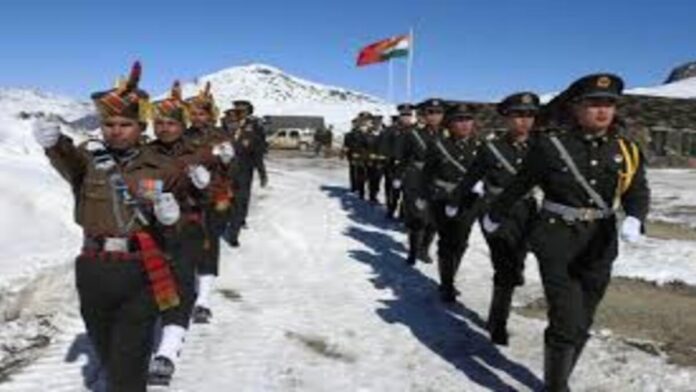
People with knowledge of the situation said Tuesday that the Indian and Chinese armies’ disengagement from Depsang and Demchok in eastern Ladakh is nearly complete, with both sides concurrently conducting joint verification of the troop and equipment pullback to a predetermined and mutually agreed distance from the face-off sites.
According to the people, who asked not to be identified, the Indian Army and the Chinese People’s Liberation Army (PLA) have dismantled temporary structures that had risen there following the start of the military standoff in May 2020 and withdrew their forward-deployed troops and equipment from the two flashpoints along the disputed Line of Actual Control (LAC) as part of the disengagement process.
“The disengagement is mostly over, and its final verification is being done in line with the agreement reached by India and China on October 21 to reduce border tensions,” said one of the people.
This will enable the Indian Army and PLA to overcome a two-year stalemate in negotiations to reduce disagreements and resolve unresolved issues along the Line of Control of China (LAC) — the fourth and final round of disengagement from Patrolling Point-15 in the Gogra-Hot Springs region occurred in September 2022, following which the negotiations came to a standstill.
According to Lieutenant General Vinod Bhatia (retd), a former director general of military operations, the disengagement at Depsang and Demchok will allow both sides to patrol in a coordinated way and with the agreed-upon frequency and strength (of the patrolling groups). “This will ensure there are no face-offs and mitigate any chances of a spiral. Since the impasse in the talks has been broken, we can now expect the two sides to chart a path to restore peace and tranquillity along LCA,” Bhatia added.
The two forces will start patrolling the disputed territories by October 31 after the disengagement, which started on October 23, went well.
By doing this, the two forward zones’ ground conditions will return to their pre-April 2020 state. In regions that were closed off due to the PLA’s forward presence, the Indian Army will start patrolling again.
Following the announcement on October 21 of a breakthrough in negotiations between China and India to end the standoff in Depsang and Demchok, the final two flashpoints in Ladakh where competing soldiers have stared eye-to-eye for nearly four and a half years, the disengagement got underway.
Only Depsang and Demchok are covered under the disengagement agreement; both nations will continue to negotiate at various levels on other regions where buffer zones were previously established following troop withdrawal.
As was the case with the first rounds of force withdrawal, buffer zones would not be established in order to disengage rival soldiers from Depsang and Demchok.
Prior to this, China and India withdrew from the Galwan Valley, Pangong Tso, Gogra (PP-17A), and Hot Springs (PP-15), where buffer zones were established to temporarily limit both armies’ patrolling capabilities. The purpose of the zones of separation was to prevent violent confrontations. The results of more negotiations will determine whether or not the moratorium on patrolling certain regions by both sides is lifted.
Indeed, the first step in reducing border tensions is withdrawal from regions of contention. To bring peace and tranquilly back to the area, the ongoing war must be de-escalated, and rival forces must eventually be de-inducted. In the Ladakh battlefield, both armies continue to maintain tens of thousands of soldiers and cutting-edge equipment.