


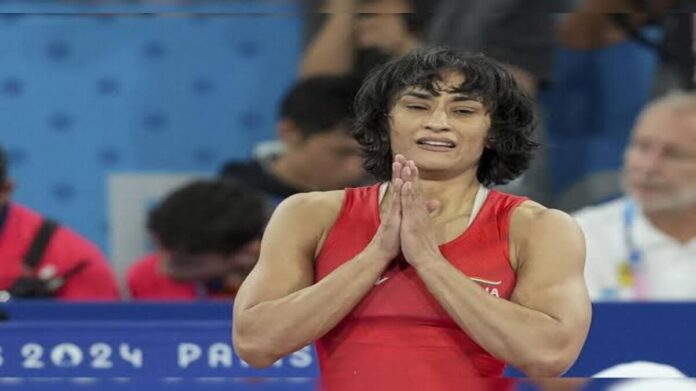
The sole arbitrator who heard Vinesh Phogat’s appeal at the Court of Arbitration for Sport (CAS) described the regulations that resulted in her complete disqualification from the Paris Olympics as “draconian,” noting that a “fairer solution” would have been to uphold the results of the first day and “limit the consequences” to just the 50-kg gold-medal bout, for which the wrestler was disqualified due to being 100g overweight.
On August 13, the Ad Hoc Division of CAS dismissed Vinesh Phogat’s appeal in a one-line ruling. The Australian arbitrator presiding over the case, Annabelle Bennett, emphasised in a 24-page detailed order on Monday that while Vinesh Phogat was found to have committed “no wrongdoing,” the United World Wrestling (UWW) competition policy’s “formation or validity” was not “subject to challenge.”
Vinesh Phogat had sought in her appeal against the UWW and the International Olympic Committee (IOC) that the decision to disqualify her be overturned and that she be given a joint silver medal. “Rules are rules,” as UWW President Nenad Lalovic once stated.
Bennett issued an order stating that she saw “logic in a rule” that “limits the consequences to the round for which the wrestler is not eligible” and would guarantee the outcome of Vinesh Phogat’s first-day matches.
“The rules do not provide for such an outcome… The rules use the words ‘eliminate’ and, further, provide that the wrestler is ranked last, without rank. CAS case law is replete with the conclusion that it is not the prerogative of CAS panels or sole arbitrators to rewrite federation rules,” she noted.
“The consequences of the failed second weigh-in, which do not arise from any illegal or wrongful act on the part of the applicant are, in the opinion of the sole arbitrator, draconian. A consequence of elimination without ranking from the round for which the athlete was found ineligible, having been eligible for the rounds for which she competed, would seem to be a fairer solution. However, it bears repeating that neither the formation or validity of UWW policy is before the sole arbitrator and there is no evidence or submission as to the reasons for such policy,” she said.
Several reasons were given by the legal team of Vinesh Phogat and the Indian Olympic Association (IOA), who were represented by attorneys Vidushpath Singhania and Harish Salve, for the second weigh-in’s failure.
They cited the need for Vinesh Phogat to “eat and drink for her health” after three “difficult competitions on August 6” and “the distance between the venue and the Athletes’ Village which left the applicant with little time for the process of losing weight before the second weigh-in the following morning”.
According to the order, while Vinesh Phogat herself did not raise the issue, the IOA’s legal team provided evidence that “she was pre-menstrual and that this results, as a normal biological process, in fluid retention”. The arbitrator, however, observed that “the evidence regarding the effects of the menstrual cycle does not distinguish between the first weigh-in when she was compliant, and the second weigh-in, when she was not.”
“Possible reasons based on biology cannot be an excuse for the failure to comply. They are, as normal biological processes which would include eating and drinking and the menstrual cycle, factors to be taken into account as a matter of course by highly experienced athletes,” she said.
The IOA even continued to argue that the scales were not accurate. Nevertheless, the accusations were rejected due to insufficient proof. The wording of the UWW’s regulations was also contested by the IOA’s legal team.
Although “that is not the relief that the applicant seeks,” the arbitrator stated that “many of her (Vinesh Phogat’s) submissions would be relevant” if she contested the rules. “The petitioner does not ask for orders to nullify the regulations or render them ineffective in any other way. The order said, “Her issue is with their application and implementation to her position.
After Vinesh Phogat’s appeal was dismissed, the IOA announced that it was looking into “further legal options.”