


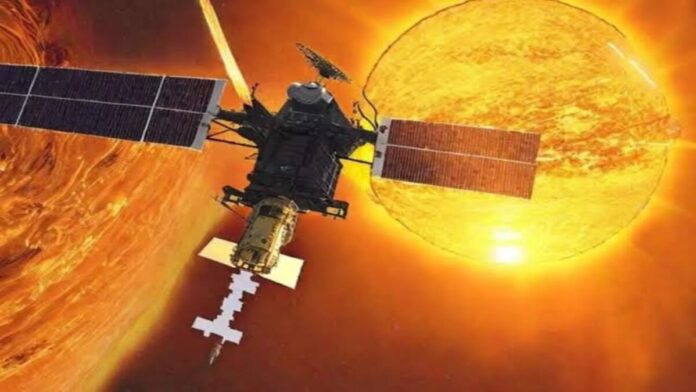
Aditya L1, India’s first space-based solar observatory, is constantly monitoring the Sun, but it will not be present for today’s complete solar eclipse, which will be visible across a large portion of North America. People in the USA are lucky enough to be able to see total solar eclipses occasionally, and many events are planned to take advantage of this unique celestial phenomena, including skydiving and special flights.
Western and northern New York State will see a total eclipse for the first time in over a century. The USA is in a frenzy as a result of the path of totality, a brief section where the Moon completely blocks out the Sun.
In its statement about the event, NASA says, “On April 8, 2024, a total solar eclipse will cross North America, passing over Mexico, the United States, and Canada. A total solar eclipse happens when the Moon passes between the Sun and Earth, completely blocking the face of the Sun. The sky will darken as if it were dawn or dusk.”
Among many other studies, NASA is also pursuing the shadow with dedicated research aircraft. The main spectacle, the transition from day to night, should only endure for approximately four minutes during the several hours that the event will last in complete darkness.
However, the event will not be seen to India’s Aditya L1 satellite. This isn’t because the Indian Space Research Organisation (ISRO) made a mistake; rather, it’s because the satellite is positioned so that it can see the Sun continuously for 365 days a year. The location was selected by Indian scientists to guarantee that an eclipse would never obstruct the satellite’s view.
“Aditya L1 spacecraft will not see the solar eclipse as the moon is behind the spacecraft, at the Lagrange Point 1 (L1 point), the eclipse that is visible on Earth doesn’t have much significance at that location,” ISRO chairman S. Somanath told news agency.
Around 1.5 million kilometres from Earth, at the Lagrange point 1 (L1) of the Sun-Earth system, is where the Indian Aditya L1 spacecraft is positioned in a halo orbit. The main benefit of having a satellite in the halo orbit around the L1 point is being able to view the Sun continually without being obscured by clouds or eclipsed by sunlight. This offers an even bigger benefit of real-time monitoring of solar activity and its impact on space weather.
Aditya L1 is a robotic research satellite designed to monitor the Sun continuously. It is around 1,500 kg in weight. This is the first mission from India specifically designed to monitor the Sun and learn more about what occurs when the Sun gets active. The cost of building the solar observatory came to 400 crore.
In reality, the Visible Emission Line Coronagraph (VELC), a unique sensor on board the Aditya L1 satellite, allows the spacecraft to efficiently study the Sun by creating its own fake solar eclipse. According to Mr. Somanath, “A solar eclipse is created in the coronagraph by eliminating the light from the disc of the Sun.”
Solar physicist Dr. Dipankar Banerjee of the Indian Institute of Astrophysics (IIAP), Bengaluru, said the spacecraft gives scientists a chance to see and examine the Sun’s corona both from space and during a total solar eclipse.
During today’s eclipse, Dr. Banerjee will be doing some ground-based experiments in Dallas, Texas, USA. The data from these tests will be compared with Aditya L1 data collected during the same viewing period.
Nothing will change in the Sun as a result of the eclipse, according to ISRO’s Project Director for the Aditya L1 satellite, Nigar Shaji.
Nothing unusual occurs to the Sun as a result of the eclipse. To investigate the coronal features in emission lines, the VELC spectroscopic channels will be used in unique observation modes such as raster scan and sit and stare. This will be a collaborative effort to confirm through on-the-ground inspections,” Ms. Shaji informs the news organisation.
Aditya L1 is equipped with seven payloads that use electromagnetic, particle, and magnetic field detectors to study the photosphere, chromosphere, and the outermost layers of the Sun, called the corona. The remaining three payloads conduct in-situ investigations of particles and fields at the Lagrange point L1, so enabling significant scientific studies of the effect of solar dynamics in the interplanetary medium. Four payloads use the unique vantage point L1 to directly view the Sun.
NASA states that “it is not safe to gaze directly at the Sun without specialised eye protection for solar viewing, with the exception of the brief total phase of a total solar eclipse, when the Moon totally conceals the Sun’s brilliant face. Severe eye damage will result immediately from looking at any portion of the bright Sun through a telescope, binoculars, or camera lens without a special-purpose solar filter fastened over the front of the optics.”