


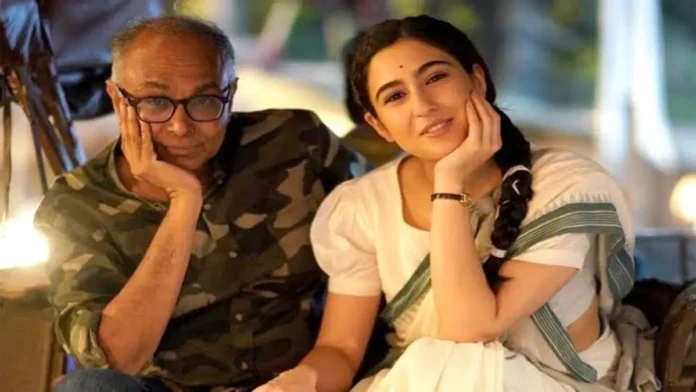
Do you recall the loud and memorable dialogue “Tum mujhe tang karne lage ho” from Imtiaz Ali’s LoveAajKal (2020)? Seeing her in Ae Watan Mere Watan and the way she delivers her lines in this historical drama gave you a strange sense of déjà vu.
The movie, to be honest, makes a real effort to tell the unique, complex, and masterfully presented story of an unsung hero in India’s liberation movement; nevertheless, Sara’s terrible language delivery, which includes multiple expressions that are out of sync, proves to be an unsurmountable obstacle. Since Sara doesn’t even speak Hindi as her first tongue, we called Rashmika Mandanna out for her bad line delivery in Animal, so it was kind of unpleasant to watch her sail in the same boat. She is fluent in Urdu and produces some incredible (ahem, ahem) poetry in shuddh (pure) Hindi. Perhaps she and the audience would have both been saved by a few lessons in dialect.
Ae Watan Mere Watan is a film that quickly transitions from black-and-white footage to sepia tones, thus it doesn’t require any context or flashbacks to explain its idea. The film transports you to the early 1940s, just before independence, and highlights the collaboration between angry young and freedom warriors in support of the Quit India Movement. Chest-thumping patriotism is a major component of Ae Watan Mere Watan, with cries of Vande Mataram and Jai Hind frequently causing disturbances between young people and British police.
Highlighting India’s struggle for freedom in 1942, the film traces the life of Usha Mehta (Sara), a young girl who braves all odds to make her hatred for the British authorities heard. It’s after the arrest of prominent freedom fighters that Usha, along with her trusted allies, Fahad (Spash Srivastava) and Kaushik (Abhay Verma), takes matter in her hands. The film showcases their journey of starting an underground radio station called Congress Radio with the sole aim of spreading the message of unity against the British rule. Following Mahatma Gandhi’s ideologies of non-violence, the motto they follow is ‘Karo Ya Maro’ (Do or die), and some of them even take an oath of celibacy. During the journey, their encounter with Ram Manohar Lohia (Emraan Hashmi) gives a new direction to their revolution, and then begins an exhilarating chase with the British authorities.
Loosely based on the life of this unsung hero, the biographical film serves as a chapter out of a history textbook. However, as the story unfolds, a bit of predictability sets in sooner that you’d imagine. Kannan Iyer returns to direction after over a decade since his directorial debut Ek Thi Daayan, and what a stark contrast of genres he picked to go behind the camera for. In his latest outing, he tries to keep the old-world charm intact, which is evident in the architecture of the buildings, narrow lanes, costumes as well as the dialect.
In her recently released Netflix India film Murder Mubarak, Sara, known for her aggressively glammed-up persona, plays a completely de-glam role in Ae Watan Mere Watan. It’s interesting to observe, though, how her outfit changes with time—from cotton suits with impeccably draped dupattas to cotton sarees and blouses with puffy sleeves. Despite her apparent effort, her subdued performance seemed a little mismatched given Sara’s attitude. She never persuades you in the same way as Usha or someone who acts with such subtlety. But there’s this one really well-performed moment where she visits a mosque while hiding behind a burqa.
Conversely, Emraan makes a strong impression as Lohia and adds weight to his performance. There are some heavyweight lines he gets to say, for instance, “Chahe kitni bhi teeliyan bujh jayein, hamare seene ki aag kabhi nahi bujhegi” (No matter how many matchsticks get doused, the fire in our hearts will always remain).
The interactions between Usha and her father, Judge Hariprasad Mehta (Sachin Khedekar), are one of the other scenes that merit mention. These beautifully written passages will touch you, whether it’s when she’s little and dreams of having wings after seeing Serbian birds soar in the sky, or when she’s an adult and tells her father she works for the Congress.
I particularly loved the whole sequence where Usha, Fahad and Kaushik are strategising how to start the radio station. From having ₹551 to buy the radio that would cost them ₹4000, Usha’s bua (paternal aunt) offering to sell her gold jewellery wanting to make some contribution in ‘desh ki azaadi’ (country’s independence) to deciding the apt timing for their broadcast when maximum junta is at home and even composing the signature tune of All India Radio — you can notice the nitty-gritties that the writing department has paid attention to.
The fact that Ae Mere Watan is set in the pre-Independence era, you can’t overlook the unapologetic usage of Hindi terminology that’s sprinkled throughout the story. So, don’t be surprised upon hearing words like avaam, azaadi, kaayar, angrez, mazhab, zaalim, yudh, balidaan, garv, kranti, vidroh, shaheed, ahinsa, parcham, sangharsh and samrajya every two minutes. Yes, I tried to take note of as many as I could and they’re long additions to your vocabulary.
Ae Watan You have to give the crew credit for trying to simplify some of the more complex tropes in Mere Watan, even though they can be difficult to understand if you’re not paying close attention. For example, the use of triangulation technique by the Bombay Police to track Congress Radio and its location is discussed in great detail. All I wish for is that similar attention would’ve been given to Sara’s dialogue delivery techniques, so it would have been a more bearable watch of over two hours.