


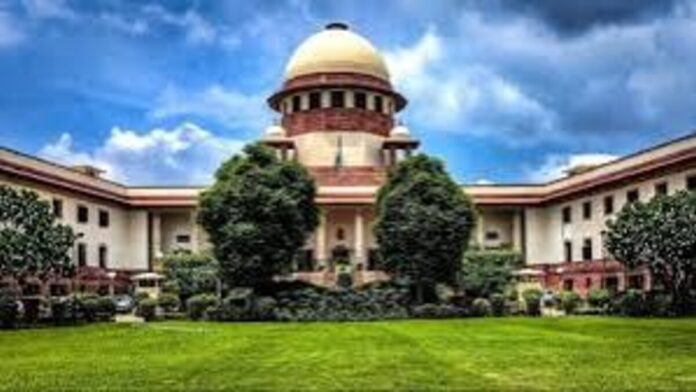
The Supreme Court is scheduled to hear a batch of over 200 petitions on Tuesday seeking stay on the implementation of controversial Citizenship (Amendment) Act, 2019 (CAA).
A bench headed by Chief Justice of India DY Chandrachud and Justices Manoj Misra and JB Pardiwala will hear the petitions today.
Referring to a petition filed by the Kerala-based Indian Union Muslim League (IUML), Senior Advocate Kapil Sibal last week said that the centre’s move to implement CAA was questionable as the Lok Sabha elections are very near.
Those who are challenging the contentious law have said the law is a discrimination against Muslims on the ground of religion.
It has also been argued that such discrimination violates the right to equality under Article 14
AIMIM chief Asaduddin Owaisi, Assam Congress leader Debabrata Saikia, Congress leader and former Union minister Jairam Ramesh, NGOs Rihai Manch and Citizens Against Hate, Assam Advocates Association, and a few law students are among the other petitioners in addition to the IUML.
The CAA Rules, 2024, which were used to implement the CAA, have also been contested by the IUML, Debabrata Saikia, Asom Jatiyatabadi Yuba Chatra Parishad (a regional student organisation), Democratic Youth Federation of India (DYFI), and the Social Democratic Party of India (SDPI).
Kerala was the first state to petition the Supreme Court in 2020 to overturn the CAA on the grounds that it violated the Indian Constitution’s guarantees of the right to equality.
Additionally, it has brought a second case to the Supreme Court contesting the CAA regulations.
In his appeal to the Supreme Court, Owaisi stated, “The evil posed by the CAA is simply not one of under-inclusion of grant of citizenship, but is very blatantly the isolation of a minority community to selectively take action against them consequential to the denial of citizenship.”
According to the head of AIMIM, plans are underway to use the 2019 update to the National Register of Citizens (NRC) to specifically target the Muslim population.
The Centre had remained steadfast in its position throughout the dispute, arguing that it would not impair citizens’ legal, democratic, or secular rights and asking the court to reject petitions that opposed it.
Five years after the CAA was approved by Parliament in December 2019, the Central government implemented it on March 11. This led to widespread protests around the nation and increased public scrutiny.
The Citizenship Act of 1955 is amended by the CAA to give migrants from Afghanistan, Bangladesh, and Pakistan who are members of the Hindu, Sikh, Jain, Parsi, Buddhist, and Christian communities and who arrived in India on or before December 31, 2014, a streamlined route to Indian citizenship because they were subjected to religious persecution back home.