


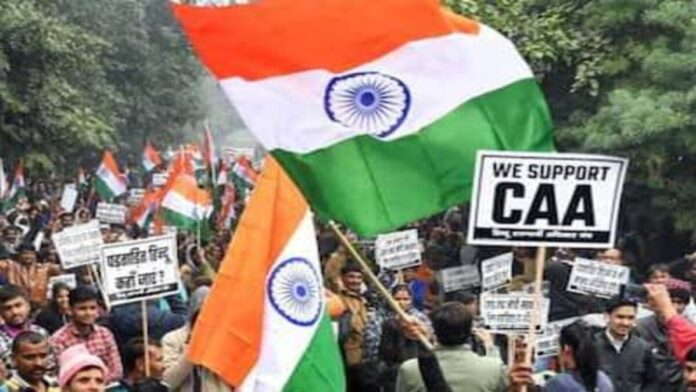
The Citizenship (Amendment) Act (CAA) regulations were announced a day ago, and the Ministry of Home Affairs (MHA) stated on March 12 that “no Indian citizen would be asked to produce any document to prove his citizenship after this Act,” in an attempt to calm Muslim concerns.
Regarding its effect on Islam and Muslims, the MHA has responded to eight questions in a press release titled “positive narrative on CAA, 2019.” Late on March 12, the document was removed from the government website.
While responding to a question on the CAA’s impact on Muslims living in India, the MHA says, “Indian Muslims need not worry as the CAA has not made any provision to impact their citizenship and has nothing to do with the present 18 crore Indian Muslims, who have equal rights like their Hindu counterparts. No Indian citizen will be asked to produce any document to prove his citizenship after this Act.”
There are concerns and worries that the Muslim community will suffer as a result of the Citizenship by Attribution Act (CAA), which grants citizenship on the basis of religion to six undocumented religious communities from Pakistan, Afghanistan, and Bangladesh who entered India on or before December 31, 2014, and is followed by a compilation of the NRC across the nation. While non-Muslims barred from the NRC will be saved by the CAA, Muslims who are barred will need to demonstrate their citizenship. Following the passing of the CAA, protests and riots in Assam, Uttar Pradesh, Karnataka, Meghalaya, and Delhi resulted in the deaths of up to 83 people. The Centre denied any connection between the CAA and the NRC, telling the Parliament that “yet the government has not taken any decision to prepare NRC at national level.”
Nonetheless, the National Population Register (NPR), which is to be updated during the first phase of the Census, is the first step towards compiling the NRC, as per the Citizenship Rules 2003 under the Citizenship Act, 1955. There is no need for new legislation in order to conduct NPR across the nation; this rule has not been changed or abandoned. Only Assam complied with the Supreme Court’s directions to assemble the NRC, and 19 lakh out of 3.29 crore petitioners were not included in the draft record.
The Ministry stated on March 12 that the CAA reduces the qualification period for acquiring Indian citizenship from 11 years to five years for the beneficiaries persecuted on religious grounds in Pakistan, Afghanistan and Bangladesh “without curtailing the freedom and opportunity of Indian Muslims to enjoy their rights as they have been usually practising and entertaining since Independence like other Indian citizens belonging to other religions.”
To a question, “Is there any provision or agreement for repatriating illegal Muslim migrants to Bangladesh, Afghanistan and Pakistan?”, the MHA says that “India does not have any pact or agreement with any of these countries to repatriate migrants back to these countries.”
Furthermore, it stated that since the CAA does not address the expulsion of undocumented immigrants, the worries expressed by some individuals—including Muslims and students—that the Act discriminates against Muslim minority are unfounded.
According to the MHA, the Citizenship Act of 1955 and the CAA both define an unlawful migrant as a foreign person who enters India without the proper documentation.
Regarding “impact of CAA on the image of Islam,” the MHA says, “Due to the persecution of minorities in those three Muslim countries, the name of Islam was badly tarnished all around the world. However, Islam, being a peaceful religion, never preaches or suggests hatred/violence/any persecution on religious ground. This Act showing the compassion and compensation for the persecution, protects Islam from being tarnished in the name of persecution.”
According to the Ministry, Muslims from all over the world are free to apply for Indian citizenship through Section 6 of the Citizenship Act, which addresses naturalisation.
The Citizenship Act of 1955 has to be changed, according to the MHA, “to show mercy on the persecuted minorities of those three countries.”
“This Act gives opportunity to them as per the evergreen generous culture of India to get Indian Citizenship for their happy and prosperous future. To customise the citizenship system and control the illegal migrants, there was a need of this Act,” the MHA said, adding that in 2016, the Central government also made minorities of the three countries eligible for long term visa to stay in India.
“The CAA does not cancel the naturalisation laws. Therefore, any person including the Muslim migrants from any foreign country, seeking to be an Indian citizen, can apply for the same under the existing laws. This Act does not prevent any Muslim, who is persecuted in those three Islamic countries for practising their version of Islam, from applying for Indian citizenship under the existing laws,” the MHA said.