


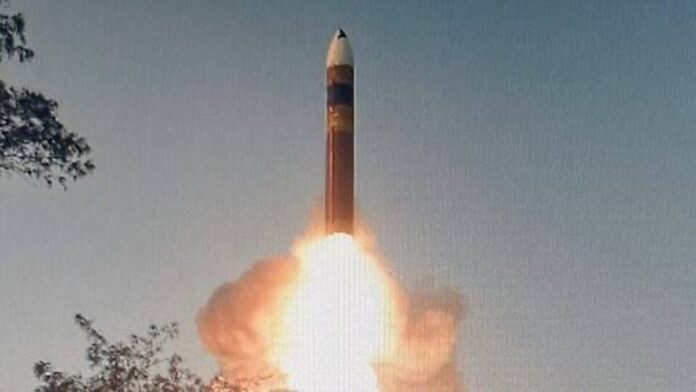
The Multiple Independently Targetable Reentry Vehicle (MIRV) technology, which enables the weapon system to counter multiple nuclear warheads, was tested in flight for the first time by India on Monday. This test strengthened the nation’s strategic deterrence capabilities. The Agni-5 missile was built in India.
With the missile launch conducted as part of Mission Divyastra, India joined the select group of nations that possess the capacity to launch MIRV missile systems, which also includes the US, the UK, France, Russia, and China.
The Defence Research and Development Organisation (DRDO) experts were congratulated on the successful test by Prime Minister Narendra Modi and Defence Minister Rajnath Singh.
“Proud of our DRDO scientists for Mission Divyastra, the first flight test of indigenously developed Agni-5 missile with Multiple Independently Targetable Re-entry Vehicle (MIRV) technology,” PM Modi said on ‘X’.
The MIRV technology, which aims to launch several warheads at various sites, was tested for the first time during the Agni-5 test flight. The re-entry vehicles were able to reach the target points with the appropriate accuracy because the Agni-5 weapon system is outfitted with high-accuracy sensor packages and native avionics systems.
According to The Centre for Arms Control and Non-Proliferation, multiple independently-targetable reentry vehicles, or MIRVs, were first developed in the early 1960s to enable a single missile to carry multiple nuclear warheads, each of which could strike different targets independently, unlike traditional missiles.
The United States was the first to use MIRV technology, launching a MIRVed Submarine-Launched Ballistic Missile (SLBM) in 1971 and a MIRVed Intercontinental Ballistic Missile (ICBM) in 1970.
The countries that have the MIRV technology are the United States, the United Kingdom, France, Russia, China, and India. Pakistan is also working towards acquiring MIRV capabilities. It is said that in January 2017, the Ababeel, a MIRVed missile, was tested there.
MIRVs are far harder to defend against than conventional missiles, even though they were not designed to overcome ballistic missile defences.
But implementing MIRV technology also presents difficult tasks, such as developing sophisticated guidance systems, miniaturising warheads, and guaranteeing the dependability of each re-entry vehicle, according to the news agency’s article.