


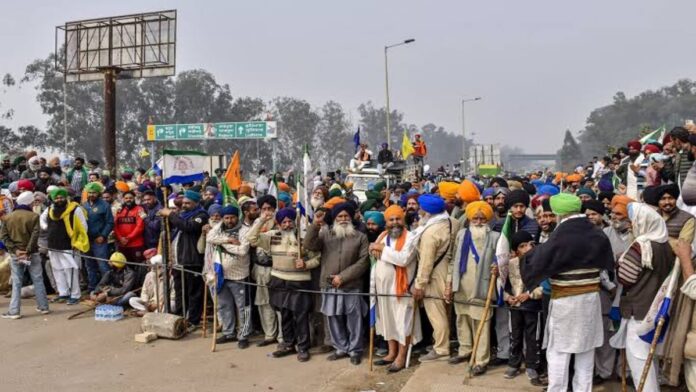
The impasse that resulted in a major confrontation on the Punjab-Haryana border last week appears to have improved following the fourth meeting between the protesting farmers and a government delegation late last night.
Following their long-lasting Chandigarh meeting, Union Minister Piyush Goyal announced that the government has planned to purchase pulses, maize, and cotton crops from Punjabi farmers at the minimum safety price (MSP) for the ensuing five years.
The farmers in protest have requested two days for their forums to debate the plan while a decision on their other demands is still awaited.
The term “MSP” describes a price set by the government to shield farmers from sharp drops in agricultural prices. It guards against losses and serves as a safety net.
Ministers Arjun Munda and Nityanand Rai met with Mr. Goyal, who informed them that government agencies will enter into a five-year contract with the farmers for the proposed procurement, with no cap on the amount purchased.
“Cooperative societies like the NCCF (National Cooperative Consumers Federation) and NAFED (National Agricultural Cooperative Marketing Federation of India) will enter into a contract with those farmers who grow tur dal, urad dal, masoor dal or maize for buying their crop at MSP for next five years,” the minister said.
A participant in the meeting, Punjab Chief Minister Bhagwant Mann stated that if farmers are to pursue crop diversification, they must have guaranteed prices.
Sarwan Singh Pandher, the head of the farmers, stated that they will consult with specialists before determining their next course of action. He also hoped that their other demands would also be resolved in the next two days.
The ‘Delhi Chalo’ march, which saw thousands of farmers heading towards Delhi with their tractors filled with ration for months, will be put on hold. But the march will resume on February 21 if all their demands are not met, he said.
In addition to an MSP law, the farmers want their loans waived, the Swaminathan Commission’s recommendations implemented, pensions for farm laborers and farmers, and the dismissal of any police cases that were brought against them during the protests.
After starting their march to Delhi on Tuesday of last week, the farmers are currently camped at the borders of Punjab and Haryana at Shambhu and Khanauri, where numerous barriers have been put up to prevent them. Since their most recent meeting, which took place four days ago, there have been no reports of any altercations with the security staff.
Along with Ghazipur, Singhu, and other partially shut borders, Delhi is also fortified. To prevent their tractors and trollies from crossing over, concrete blocks and nails are positioned on the roadway.