


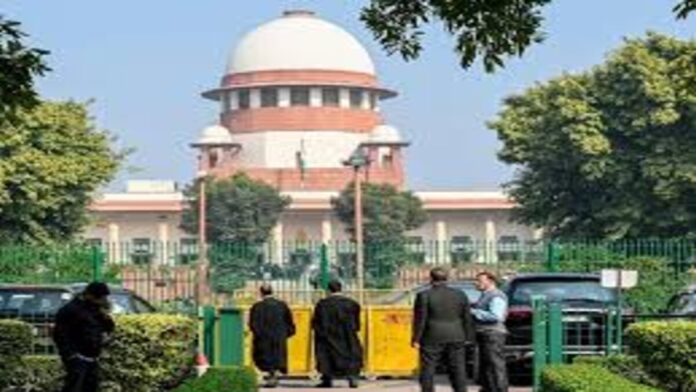
Today, the Supreme Court will rule on a number of cases that contest the legality of the electoral bonds programme. On November 2 of last year, a five-judge Constitution bench headed by Chief Justice DY Chandrachud reserved its decision. When the administration unveiled the electoral bonds programme on January 2, 2018, it was thought to be a way to improve openness in political fundraising and take the place of cash contributions.
Using electoral bonds, people and companies can make anonymous financial contributions to political parties without disclosing who they are. Any Indian individual or organisation incorporated or founded in the nation may purchase electoral bonds under the terms of the plan. These bonds can be purchased at any State Bank of India branch and come in a range of denominations from ₹ 1,000 to ₹ 1 crore (SBI). Additionally, these gifts are interest-free.
The petitioners contend that the electoral bonds programme violates Article 19(1)(a) of the Constitution, which guarantees citizens the right to know whence their political parties receive their funds. Senior counsel Prashant Bhushan had stated last year, appearing on behalf of the petitioners, that the “opaque” and “anonymous instrument” encourages corruption.
Attorney General R Venkataramani said that Article 19(1)(a) did not provide citizens with an absolute right to information about the source of monies used to fund political parties through electoral bonds, prior to the Supreme Court’s hearing in November. According to him, the electoral bond programme encourages clean money and openness in elections. Mr. Venkataramani insisted, however, that the right to information has restrictions and cannot be an unbridled right to know “anything and everything.”
“The scheme in question extends the benefit of confidentiality to the contributor. It ensures and promotes clean money being contributed. It ensures abiding by tax obligations. Thus, it does not fall foul of any existing right,” he had said.
A study claims that the BJP obtained around ₹ 1,300 crore through electoral bonds in the 2022–2023 fiscal year, while the Congress received seven times less during that same period.
Electoral bonds contributed 61 per cent of the ₹ 2,120 crore total donations made by the BJP throughout the year. The entire contributions made by the BJP in the previous fiscal year 2021–2022 was ₹ 1,775 crore. The party claimed to have made ₹ 2,360.8 crore in total revenue in 2022–2023.
On the other hand, Congress faced a reduction in their electoral bond revenues, bringing in ₹171 crore in 2022–2023 as opposed to Rs 236 crore in 2021–2022 fiscal year.
Electoral bonds can only be obtained by political parties that are registered under Section 29A of the Representation of the People Act, 1951, and that have received at least 1% of the votes in the most recent Lok Sabha or state legislative assembly elections. Additionally, as stated in the announcement, eligible political parties are the only ones who may redeem these bonds via an approved bank account.
The Supreme Court refused to halt the electoral bonds programme in April 2019, citing the necessity for a thorough hearing because of “weighty issues” brought up by the Election Commission and the Centre. The current Constitution bench, comprising Justices Sanjiv Khanna, BR Gavai, JB Pardiwala, and Manoj Misra, began hearing arguments on October 31 last year. The petitions included those filed by Congress leader Jaya Thakur, the Communist Party of India (Marxist), and the NGO Association for Democratic Reforms (ADR).