


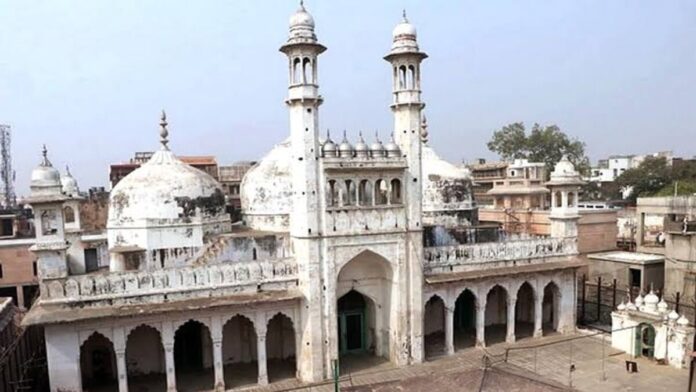
On Wednesday, the Varanasi District Court permitted Hindus to say prayers within the Gyanvapi mosque complex’s Vyas Ka Tekhana, a sealed subterranean space. The district administration was ordered by the court to arrange for the puja to begin within seven days.
The counsel for the Anjuman Intezamia Committee of Gyanvapi Masjid, Merajuddin Siddiqui, has stated that the committee will contest the order in the Allahabad High Court. The committee’s advisory body, the All India Muslim Personal Law Board (AIMPLB), compared the district court’s ruling to the 1986 inauguration of the Babri Masjid and declared it “totally unacceptable.” “It seems after establishment of Ram Mandir at the site of the Babri Masjid, many other mosques are being targeted, no matter how old they might be,” AIMPLB spokesman S.Q.R. Ilyas told news agency.
According to the petitioner, Hindu priests appointed by the Vyas family had performed daily rituals in the temple at this spot within the complex before 1993, till it was stopped on the orders of the State government. However, an Anjuman Intezamia committee member, who did not wish to be named, contested the claim. “There has never been any puja conducted there. It is a baseless contention,” he said.
The order permitting prayers to resume came on the last working day of district judge Ajay Krishna Vishwesha, who has been hearing multiple pleas related to worship rights in the Gyanvapi mosque. In one instance, the Acharya Ved Vyas Peeth temple priest Shailendra Kumar Pathak requested that the visible and unseen deities be worshipped in the mosque’s basement in an application that was submitted in September 2023.
“District Magistrate, Varanasi is directed to get puja, raga-bhog performed of idols located in the southern cellar of Gyanvapi Mosque. This would be done through a priest nominated by Kashi Vishwanath Trust Board and plaintiff. Make proper arrangements of iron fencing etc. in 7 days for the same,” reads the court order, of which a copy is available with the news agency. The district government of Varanasi was directed by this court on January 24 to assume control of the southern cellar located within the Gyanvapi mosque complex.
The defendants, including the Anjuman Intejamia Masajid Committee, which oversees the Gyanvapi mosque, have until February 8 to register their objections on the next hearing date in this case.
According to the AIMPLB, the mosque committee was planning to file an appeal with the High Court. “The case is likely to be listed tomorrow. The Muslim side was not given the chance to present its viewpoint by the district court. The judge gave the verdict on his last day in service,” Mr. Ilyas said.
Alok Kumar, the international working president of the Vishwa Hindu Parishad, responded to the court’s decision permitting Hindus to worship in the Gyanvapi mosque’s basement by saying that the ruling was momentous and had made the Hindu community happy.
“In the basement of the Gyanvapi structure on the southern side is a Temple and in this Temple the regular Puja Archna of the Deities was going on till the year 1993. In 1993, the administration had, in an arbitrary action, barricaded the area, prohibited the Hindus from going to the Temple and had stopped the Puja Archna,” he said in a statement. Additionally, Mr. Kumar expressed his hope that this injunction will serve as a springboard for a swift ruling on the main lawsuit.
But the AIMPLB is drawing comparisons between the 1986 lock-opening of the Babri Mosque and the decision to allow puja in the basement of the Gyanvapi mosque.
“They are moving in the same direction. There is reason to draw parallels and we fear history is being repeated. Here, in Gyanvapi, five Hindu women sought right to worship a deity here. Then claims were made about a shivling in the wuzukhana. Then the wuzukhana was sealed. Following that, the Archaeological Survey of India was asked to conduct a survey of the mosque. Soon its report was leaked to press after the court gave a copy to the two parties. Now, permission for puja has been granted. Nobody bothered to find out if this case could even be listed after the Places of Worship Act came into force in 1991,” said Mr. Ilyas.
The Allahabad High Court has sent a notice to the mosque committee regarding a revision application that was filed to challenge the Varanasi district judge’s order declining to order the Archaeological Survey of India (ASI) to conduct a scientific survey of the wazukhana area of the mosque. This is just one of the significant orders pertaining to the Gyanvapi mosque.
Rakhi Singh, one of the Hindu plaintiffs in the main litigation over the Gyanvapi mosque, has filed the revision plea. She is requesting that the mosque be demolished and that Hindus be granted the freedom to worship Shringar Gauri there. The Hindu was informed by attorney Saurabh Tiwari, speaking on behalf of Ms. Singh, that a notice about the revision plea had been issued by Justice Rohit Ranjan Agarwal’s single judge bench.
In compliance with the Varanasi district judge’s directive, the ASI carried out a scientific investigation of the Gyanvapi complex in 2023 to ascertain whether the mosque was built atop an earlier Hindu temple construction. Before the current building, the Gyanvapi mosque, was built, according to the ASI’s study, a sizable Hindu temple was on the site.