


In accordance with Article 3 of the Indian Constitution, the Kuki Inpi Manipur (KIM), the supreme authority of all Kuki tribes in the northeastern state, has “explicitly” stated that its desire for a distinct administration entails a new state.
In a press release distributed to the media on Thursday, KIM general secretary Khaikhohauh Gangte stated that the choice for a state was made on July 12.
“Following its (KIM’s) crucial cabinet meeting on July 12, 2023, and the Executive Decision taken thereof, the Kuki Inpi Manipur explicitly stated its demand for separate administration in the form of separate State under Art. 3 of the Indian Constitution…,” Gangte said.
Under Article 3, Parliament can form a new state by separating territory from any state or by uniting two or more states or parts of states or by uniting any territory to a part of any state.
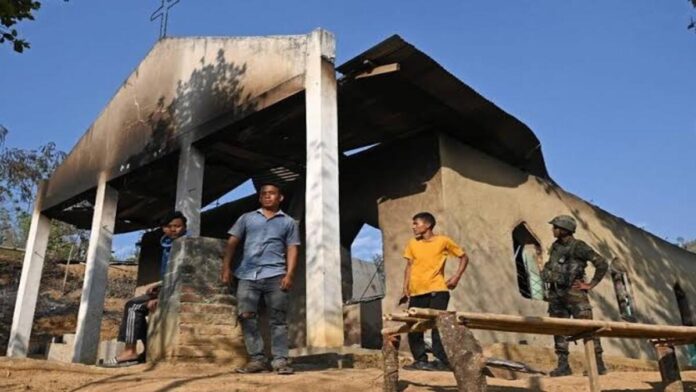
According to Gangte’s statement to the media, among other reasons for the demand are the “hounding” of “all” Kukis out of the Imphal Valley after they “burned down their colonies/settlements and churches.”
Even though Kuki-Zo organizations have been adamant about calling for a separate government ever since fighting between the Meitei and Kuki communities broke out on May 3, no one has yet stated that a new state is the only way to bring about long-lasting peace in the unstable region.
The first to do so was Kuki Inpi Manipur. As of yet, other Kuki-Zo organizations have not followed suit. In our press release, we discussed the justifications for a state, according to Janghaolun Haokip, secretary for information and publicity at KIM.
Organizations of the Meitei have vigorously opposed any form of independent government or alteration of the state’s territorial integrity.
The Kuki-Zo people allege they cannot coexist with the Meitei in the Imphal valley and blame the state government, which is led by chief minister and BJP leader N. Biren Singh, for the continuing conflict, which has so far resulted in at least 150 fatalities and 60,000 people being displaced.
Due to their shared heritage, culture, and history, tribes including the Kuki, Chin, Zomi, and Mizo are also referred to as the Zo tribes or the Zo people.
Gangte, the KIM general secretary, said the scale and intensity of the “institutionalised violence” reached catastrophic proportion wherein “even our” elected representatives are not spared, let alone bureaucrats and police officers (central and state services), showing that the “ever-widening differences between the Kukis and the Meiteis remain irreconcilable”.
The KIM also touched upon certain acts dealing with protected forest and reserved forest that have been “forcibly imposed in our land — the abode of our forefathers — since time immemorial”.
“This clearly indicates that not only could we not live and settle in the state capital (Imphal)… the very existence of the Kukis as a people remain threatened,” Gangte said.
The majority Meitei, mostly Hindus, live in the six valley districts while the Kuki and Naga tribes, mostly Christians, reside in the 10 hill districts.
“As a matter of fact, demographical/geographical separation has come into effect now. It is therefore, pertinent on the part of the central government to expedite separate administration in the form of creation of a new state under Art.3 of the Indian Constitution for lasting peace in the region,” Gangte said.
Gangte added that the Kukis shall “continue” to strive together “with sweat and blood to protect our rights and liberties until our political demand is realised in the form of Separate State”.