


On Wednesday, the AAP expressed “in-principle support” for the Uniform Civil Code (UCC), a contentious issue between the BJP and the Congress that also received “strong” criticism from the All India Muslim Personal Law Board (AIMPLB) and the Indian Union Muslim League (IUML).
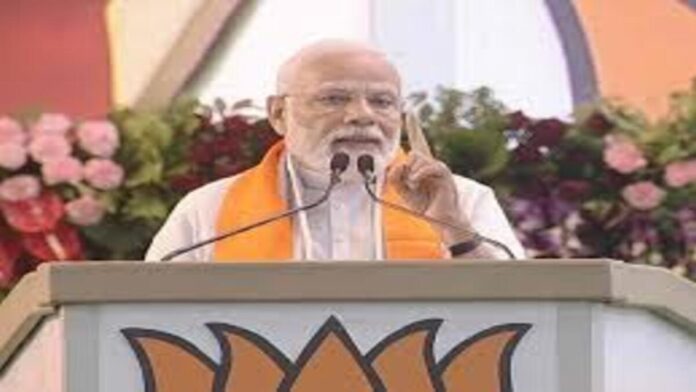
A day after Prime Minister Narendra Modi made a passionate case for the adoption of UCC at a BJP rally in Bhopal, the Aam Aadmi Party (AAP) expressed support but added that the code should be implemented with a consensus following comprehensive engagements with stakeholders.
In their attempts to form an alliance to challenge the BJP in the 2024 Lok Sabha elections, the opposition parties were not on the same page over the politically delicate topic, as seen by the position taken by the Arvind Kejriwal-led party, which is in power in Punjab and Delhi.
Defence Minister Rajnath Singh bemoaned that attempts are being made by political opponents to provide communal colour if the Centre talks about implementing the UCC, which sparked a political discussion.
He said that society should not be divided for political purposes but should instead be taken as a whole. “What we are going to do has been written in the Indian Constitution. We are going to fulfil the same promise. Isn’t there one country, one legislation?” the senior BJP leader said addressing a rally in Jodhpur.
The term “UCC” refers to a common body of rules that are applicable to all Indian citizens, are not based on religion, and deal with a variety of personal issues, including marriage, divorce, inheritance, and adoption.
Rahul Gandhi, the leader of the opposition Congress party, made a covert allusion to Modi’s push for the UCC before the forthcoming round of Assembly elections and the 2024 Lok Sabha elections. Gandhi made this statement as his party stepped up its criticism of the federal government over the growing costs of necessities.
AAP national general secretary (organisation) Sandeep Pathak said the Centre should hold extensive consultations on UCC with all stakeholders, including political parties and non-political entities, “The AAP supports UCC in principle. Article 44 (of the Constitution) also supports it,” Pathak said.
But the government should bring in UCC only when there is a consensus among the stakeholders, he added.
“We believe that on such issues we should go ahead with consensus. We believe that this (UCC) should be implemented only after there is a consensus among all the stakeholders.” The AIMPLB went into a huddle to build its case against the UCC and held a meeting Tuesday night through video conferencing.
According to AIMPLB member Khalid Rasheed Farangi Mahli in Lucknow, the draught paper that will be submitted to the Law Commission was considered.
Mahli asserted that the AIMPLB meeting was ordinary and shouldn’t be connected to the prime minister’s remarks against UCC.
“Our stand is that UCC is against the spirit of the Constitution and we will oppose it strongly,” he said.
“India is a country where many religions and cultures are followed. So, the UCC is not only going to affect the Muslims, but also the Hindus, Sikhs, Christians, Jains, Jews, Parsis and other miniscule minorities.”
The JD(U), which recently held the large-scale opposition gathering in Patna, condemned Modi’s remarks on the UCC as a “political stunt” for the Lok Sabha elections the following year and claimed they had nothing to do with the welfare of minorities.
This viewpoint was shared by the Sharad Pawar-led NCP, which stated that bringing up the UCC issue was a “political ploy” and that such choices shouldn’t be made quickly. “We have not advocated for or against UCC. After a meeting of the party’s various branches, NCP working president Praful Patel told reporters, “We are merely asking that such a significant decision should not be hastened through.
Mukhtar Abbas Naqvi, a BJP politician and former Union minister, took aim at the opposition parties, claiming that it is time to rid the UCC of these “communal crafters” because it serves the entire population rather than just one particular community.
Speaking to reporters, he added that the Congress should make it clear whether it supports the UCC as required by the constitution or is engaged in a “communal conspiracy” to prevent its implementation.
According to Naqvi, the demand and need for the UCC was repeatedly expressed from the Constituent Assembly to Parliament, from the streets to civil society and the Supreme Court.
The UCC, he continued, remained a part of the Constitution’s guiding principles rather than becoming a part of the Constitution due to “communal confusion” that was formed over it.
An “agenda-driven majoritarian government” cannot impose the code on the populace, according to senior Congressman P. Chidambaram, as doing so will “widen divisions” among them.
The prime minister, according to the former union minister, was pushing for UCC to draw attention away from the problems of unemployment, rising prices, and hate crimes. Additionally, he claimed that the BJP was polarising society through UCC.
The senior Congress leader noted that a UCC is a goal, adding that “it cannot be forced on the people by an agenda-driven majoritarian government.” The IUML, a supporter of the Congress and a member of the opposition UDF in Kerala, claimed that Prime Minister Modi was promoting the UCC mainly as a campaign platform in preparation for the Lok Sabha elections next year because he had nothing to show for his nine-year administration.
Senior IUML members, including the party’s state president Sayyid Sadik Ali Shihab Thangal, its national general secretary P K Kunhalikutty, and MP E T Muhammed Basheer, announced their decision to oppose the UCC following a meeting held in Malappuram.
The introduction of UCC, according to the Shiromani Akali Dal (SAD), would have a negative effect on tribal and minority populations.
The AAP was criticised by the opposition party in Punjab for giving the UCC its “in-principle” support, claiming that the move revealed the AAP’s “anti-minority face.” Senior SAD politician Daljit Singh Cheema said the party thought that the country’s civil laws were influenced by faith, belief, caste, and customs and that they varied for different religions in a statement released in Chandigarh.
“These should be kept in order to preserve the social fabric and the notion of unity in diversity.” The UCC campaign has been praised by the Vishva Hindu Parishad (VHP), which claims it will help put a stop to discrimination against women.