


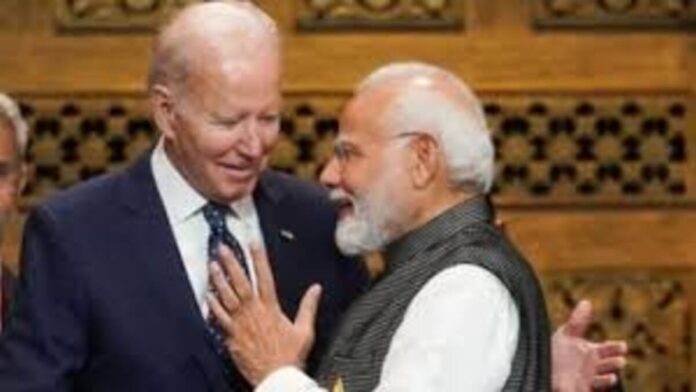
A new era in India-US relations has begun as a result of Prime Minister Narendra Modi’s visit. The two nations have developed their relationships beyond a simple buyer-seller exchange and decided to co-produce vital technology. Even though defence and strategic partnership negotiations took up the majority of Modi’s visit, there were important other accomplishments as well, such as the announcement by leading US technology company Micron Technology that it would invest up to $825 million (roughly Rs 6,770 crore) in India to establish a semiconductor assembly and testing facility.
Two cooperative taskforces on advanced telecommunications, focusing on Open RAN and research and development in 5G/6G technologies, have been established by India and the US. The US Next G Alliance and the Indian Bharat 6G Alliance will lead public-private cooperation between vendors and operators, according to a joint statement released following the bilateral meeting between Prime Minister Modi and US President Joe Biden.
Regarding nuclear energy, both parties commended the US Department of Energy and India’s Department of Atomic Energy’s expanded consultations as a means of facilitating Westinghouse Electric Company’s ability to create a techno-commercial offer for the Kovvada nuclear power project in Andhra Pradesh. On renewable energy, the joint statement stated: “The United States and India will endeavour to develop a first-of-its-kind, multibillion-dollar investment platform aimed at providing catalytic capital and de-risking support for such projects.”
Additionally, an agreement to fight climate change and reach Indian Railways’ goal of net-zero carbon emissions by 2030 was announced by the US Agency for International Development (USAID) and Indian Railways. In accordance with the agreement, the experience, resources, and ingenuity of the two parties will be combined to expedite the adoption of technologies for energy storage, energy efficiency, and renewable energy, all of which are in line with the net-zero objective. In order to improve energy efficiency, reduce carbon footprints, and assure a cleaner future for railway operations, USAID and Indian Railways are working to develop sustainable solutions.
Among the many lessons learned from Modi’s trip to the US, defence received much emphasis. The collaborative production of GE Aerospace’s F414 engines in India was the largest announcement. GE Aerospace signed an MoU with Hindustan Aeronautics Limited (HAL) for the purpose. “The agreement includes the potential joint production of GE Aerospace’s F414 engines in India, and GE Aerospace continues to work with the US government to receive the necessary export authorisation,” GE Aerospace said in a statement.
The US Congress must, however, approve the measure. For the 83 LCA (Light Combat Aircraft) that HAL is currently producing for the Indian Air Force (IAF), GE404 engines are used. The US company reported that 99 additional GE F404 engines were ordered for the LCA Mk1A and 75 had already been delivered. As part of a continuing plan to create a more potent and advanced LCA Mk2, eight GE F414 engines had been supplied.
Only three nations—the US, Russia, and France—have the technology to fully design, develop, and construct military aircraft engines, despite the fact that there are almost 40 aircraft manufacturers worldwide.
Modi’s visit included a second a deal for 31 MQ9B Predator drones. Although Modi and Biden didn’t mention the drone accord in their speech, they did in their joint statement. The purchase of General Atomics MQ-9B HALE UAVs by India was praised by President Biden and Prime Minister Modi. The MQ-9Bs, which will be built in India, would improve India’s armed forces’ ISR (intelligence, surveillance, and target acquisition) capabilities across domains. In order to support India’s long-term objectives to strengthen its domestic defence capabilities, General Atomics will also create a comprehensive global MRO facility in India as part of this plan, according to the joint statement.
For more than five years, India and the US have been discussing a drone agreement, but certain domestic officials have opposed to the cost, which is expected to be approximately $3 billion (around Rs 24,585 crore). A cabinet approval is still needed following pricing negotiations before the final contract is signed, even though the Defence Acquisition Council (DAC), the ministry of defense’s top council for military procurement, gave its approval just last week. General Atomics Aeronautical Systems partnered with Bharat Forge in India earlier this year to create landing gear parts, subassemblies, and assemblies for Predator drones.
If the drone agreement is approved, it will be the first tri-service purchase made by India to coordinate the operational and purchasing needs of its armed services. The Indian Navy, the deal’s principal agency, will receive 15 drones, while the Army and IAF will each receive eight.
Drones have been used by India for intelligence, surveillance, and reconnaissance missions over the Arabian Sea, the Bay of Bengal, the Andaman and Nicobar Islands, the Line of Actual Control with China, and locations near the waters of the Maldives. The military was forced to choose imports since India’s efforts to create a deadly armed drone similar to the MQ-9 Reaper failed to make any progress. The MQ-9B drone has a 6,000 nautical mile range and can transport payloads weighing roughly 1,700 kg. It can carry sensors and laser-guided bombs besides air-to-ground missiles, with a maximum payload of two tonnes.