


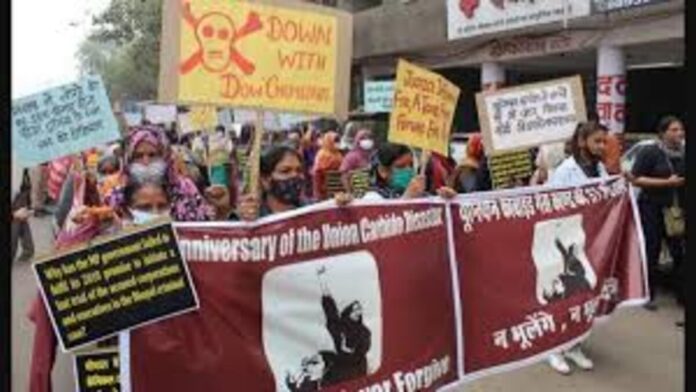
Those who lost loved ones in the tragedy referred to the Supreme Court’s decision as a “betrayal” hours after the court rejected the center’s request for additional recompense in the Bhopal Gas Tragedy case.
The poisonous gas leak at the Union Carbide plant on December 2, 1984, which is regarded as the worst industrial catastrophe ever, affected over a lakh people. The number of fatalities is estimated to be between 5,000 and 25,000.
Rashida Bi’s family suffered a tragic loss of seven relatives. She told a news agency that they are still experiencing health effects from the gas leak while speaking to them at her Bhopal house. “The heath issues persist. Today my sibling was hospitalized. The court’s decision is unfair, she claimed.
The bench’s “pro-corporate bias,” she claimed, prevented the Bhopal casualties from having their day in court. While the attorney for the survivors’ organizations was heard for only 45 minutes, the Union Carbide attorney received adequate time to talk.
The Center had asked Union Carbide’s successor companies to pay it an extra 7,844 crore rupees in damages. In 1989, a 715 crore settlement was given. The center had claimed that the extent of the environment’s and human lives’ damage could not have been accurately assessed at the time of the settlement.
The center, however, was told by the judge that there was no justification for bringing up the matter at this time. Senior advocate Harish Salve, speaking on behalf of the Union Carbide successor companies, told the court that the rupee’s depreciation since 1989 cannot be used as justification for requesting a “top-up” of recompense at this time.
Another catastrophe survivor named Shehzadi stated, “There was a betrayal in 1989. This is yet another deception.
The head of a group advocating for the survivors, Balkrishna Namdeo, questioned how the court could “draw the curtain” while those impacted by the gas leak catastrophe continue to perish and endure suffering.
“How can you enforce closure when the victims of the corporation’s crimes still suffer? When do people still pass away prematurely from cancer and other chronic illnesses brought on by their exposure to the toxic gas? “, he questioned.
“How can a Supreme Court bench draw the curtains over the injustice in Bhopal when the criminal remains at large and the suffering of the victims, including that of their children, persists?” M. Namdeo enquired.
Warren Anderson, the former chairman of Union Carbide, was the main accuser but did not show up for the hearing. In 1992, a Bhopal court proclaimed him to be a fugitive. Before his passing in 2014, two non-bailable orders were issued.
Seven Union Carbide India Limited officials were given two-year prison terms on June 7, 2010, by a court in Bhopal.