


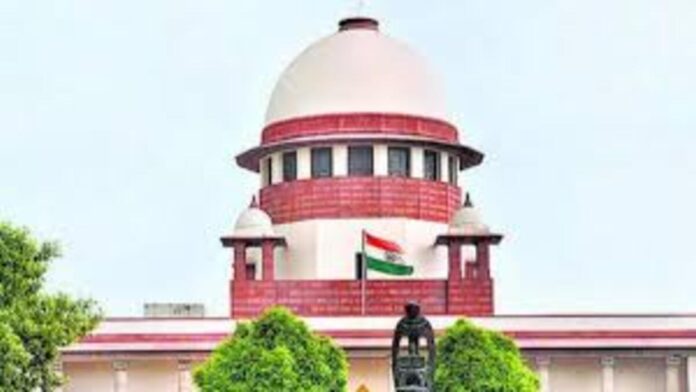
The petitions for formal recognition of same-sex marriages were referred by the Supreme Court on Monday to a five-judge Constitution Bench because the issue presents “seminal importance” issues.
In its ruling, a three-judge panel led by Chief Justice D.Y. Chandrachud noted that, in addition to transgender couples’ rights, the comments on the matter also address the interaction between constitutional rights and particular legislative provisions, such as the Special Marriage Act.
“Having due regard to the broader context of the petitions…and the interrelationship between the statutory regime and constitutional rights, we are of the considered view that it will be appropriate if the issues raised are resolved by a Constitution Bench of five judges of this court having due regard to the provisions of Article 145(3) of the Constitution,” the bench said.
A minimum of five judges are required to hear cases that contain “a substantial question of law as to the interpretation” of the Constitution, according to Article 145(3).
The case was scheduled for hearing on April 18 by the panel, which also included Justices P S Narasimha and J B Pardiwala.
The government has opposed the petitions and urged the Supreme Court to allow the matter to be decided by the Parliament. It has informed the supreme court that any interference “would cause complete havoc” and that a “legislative understanding of marriage in the Indian statutory and personal law regime” applies only to marriages between biological males and women.
The government argued that despite the decriminalization of Section 377 (homosexuality) of the IPC in Navtej Singh Johar v. Union of India, same-sex marriage cannot be legally recognized. Any “recognised deviation can occur only before the competent legislature,” the government added.
Asserting that “nobody is interfering” with “the right to love, the right to express, and the freedom of choice” as stated in the Navtej Singh Johar decision, Solicitor General Tushar Mehta appeared for the Centre on Monday.
He did, however, note that the Supreme Court was “very, very careful” in stating that this decision “should not be meant as conferring any right, including the right to marriage.”
“When it comes to granting recognition or legal sanction to a relationship, that is essentially a function of the legislature, and for a number of reasons,” Mehta said.
“Parliament will have to discuss and decide whether we would like this institution to be recognized in light of the societal ethos and several other elements which go into the lawmaking.
Mehta claimed that the Centre’s affidavit referred to provisions in various laws governing marriage that explicitly relate to only biological men and women and that, if same-sex marriage is legalized, the provisions would become superfluous.
Countering this, Senior Advocate Abhishek Manu Singhvi, who appeared for some of the petitioners, said it is about “the right to love that the SC explained in its judgment decriminalising same-sex relations is the right that makes us human”.
The right to marry “cannot be withheld from a class of persons solely on the basis of their sex, sexual orientation, or gender identity,” he said, listing the consequences of the decriminalization of Section 377.
If the freedom to marry is extended to these classes, according to him, it should be done on an equal footing.
The senior attorney argued that the Special Marriage Act’s prior notice time requirement for individuals planning to get married should also be eliminated.
The Special Marriage Act refers to marriage between any two people, according to senior advocate N K Kaul, who is also representing some applicants.
He claimed that the Supreme Court “categorically stated that the right to life includes dignity and choice of family, marriage, procreation and sexual orientation and it inheres in every individual including the LGBTQ community” in the Navtej Singh Johar ruling.
The Supreme Court ruled in the Puttaswamy case that same-sex couples have the right to private when making important life decisions, including the decision to get married.
In Deepika Singh, the SC ruled that same-sex couples’ unconventional displays of love and family are equally deserving of legal security and benefits under various laws, Kaul said.
“If we take a comprehensive view of all of these judgments, the rights that your lordships have recognized of same-sex couples and the community are far beyond a narrow pedantic interpretation sought to be given to the Special Marriages Act by saying that male and female is used in one paragraph,” he said.
The petitions, according to senior advocate K V Viswanathan, explicitly challenge Article 19(a) and 21 of the Constitution.
“The freedom to select a partner and enjoy married status is truly a freedom of expression, a right to dignity, and a right to respect oneself, all of which can be traced back to Article 21.
Because these rights have other implications, such as inheritance, family pensions, etc., they will need to be recognized and laws appropriately tailored to do so, he said.
The petitioners’ senior attorney Menaka Guruswamy stated that because Section 5 of the Act refers to marriage between two Hindus, same-sex unions must be recognized in order to fulfill the legislative purpose of the Hindu Marriage Act.
“When Ambedkar presented this, the objections he received on inter-caste marriage, widow remarriage, etc. were similar to what the Solicitor General is saying now,” the speaker claimed.