


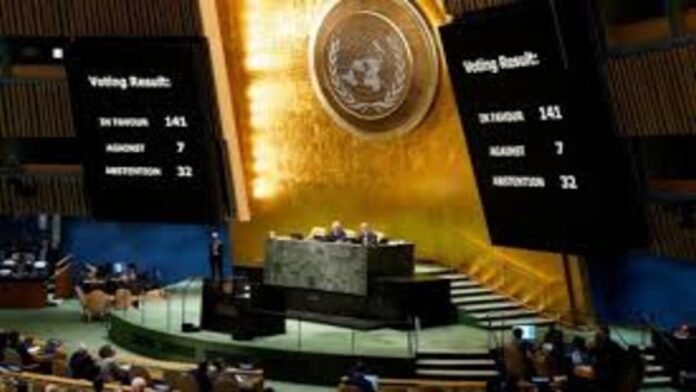
The UN General Assembly approved a resolution calling on Russia to stop its invasion of Ukraine, and in a rebuke to Moscow, India once more chose to abstain. The vote on the resolution sponsored by Ukraine and more than 65 co-sponsors took place on Thursday, the eve of the first anniversary of the invasion, while simultaneously a roundtable sponsored by India’s mission to explore the concept of “Gandhian Trusteeship” for world peace was taking place next door.
India’s Permanent Representative to the UN, Ruchira Kamboj, rushed from that meeting to the General Assembly chamber and explained the country’s absence by saying, “We will always call for dialogue and diplomacy as the only viable way out.”
The resolution called for “diplomatic efforts to achieve a comprehensive, just and lasting peace in Ukraine, consistent with the Charter,” but it made no mention of peace talks to end the war.
Can any procedure that excludes either of the two sides ever result in a credible and significant resolution?, Kamboj questioned.
While acknowledging the resolution’s stated goals, she said, “we are compelled to abstain given its inherent limitations in achieving our desired goal of securing lasting peace.”
Kamboj cited the frequently quoted line from Prime Minister Narendra Modi that “this cannot be an age of war” and added, “Elevating hostilities and violence is not in anyone’s interest. The best course of action is to quickly return to the road of negotiation and diplomacy.
The Assembly, which still has voting powers for 191 of its 193 members, passed the resolution with 141 votes in favor, seven against, and 32 abstentions.
In order to achieve a “comprehensive, just, and lasting peace,” the document condemns Russia’s invasion and calls for its urgent withdrawal. Additionally, it calls for victims’ rights and the punishment of offenders.
Prior to this decision, two amendments to the resolution proposed by Belarus, a close ally of Russia, were defeated with only 11 and 15 votes, respectively.
India did not vote in favor of the amendments that attempted to remove mentions of Moscow’s invasion and acts of aggression as well as the demand that it leave the occupied regions in favor of an end to the supply of weapons to Ukraine.
Munir Akram, the Permanent Representative of Pakistan, brought up Kashmir in a side discussion and compared it to Ukraine, which the resolution’s sponsors chose to disregard.
At a time when everyone has agreed that the path of peace can be the only way forward to resolve conflict, after two days of intense discussion, Pratik Mathur, a counselor at India’s mission, called it a “uncalled for provocation” that was “particularly regrettable and certainly misplaced at the time.”
“Reports from the ground portray a complex scenario with the conflict intensifying on several fronts,” Kamboj said, despite the backing of member states for diplomatic efforts to end the conflict and UN Secretary-General Antonio Guterres’ efforts to promote a comprehensive peace.
Due to the paralysis of the Security Council brought on by Russia’s vetoes, the General Assembly took up the resolution in an extraordinary session. This has highlighted the need for reforms, which India has been advocating for.
“Has the UN system, and particularly its principal organ, the UN Security Council, based on a 1945 world construct not been rendered ineffective to address contemporary challenges to global peace and security?” asked India’s Permanent Representative to the UN.
Only the five nations that were deemed to have prevailed in World War II were granted veto power in the Council. Resolutions passed by the General Assembly, as opposed to those passed by the Security Council, only have moral weight.
India has abstained on each of the six resolutions on Ukraine since the invasion started on February 24 of last year. Thursday’s decision was no different.
Kamboj said that India was concerned that the “conflict has resulted in the loss of countless lives and misery, particularly for women, children and the elderly, with millions becoming homeless and forced to seek shelter in neighbouring countries… economic reports of attacks on civilians and civilian infrastructure are also deeply concerning”.
She continued by saying that India was doing its bit to deal with the consequences in the Ukraine and elsewhere.
Despite the fact that they are facing rising prices for food, fuel, and fertilizers as a result of the ongoing war, she said, we are giving Ukraine humanitarian aid while also supporting some of our neighbors in the Global South who are experiencing economic hardship.