


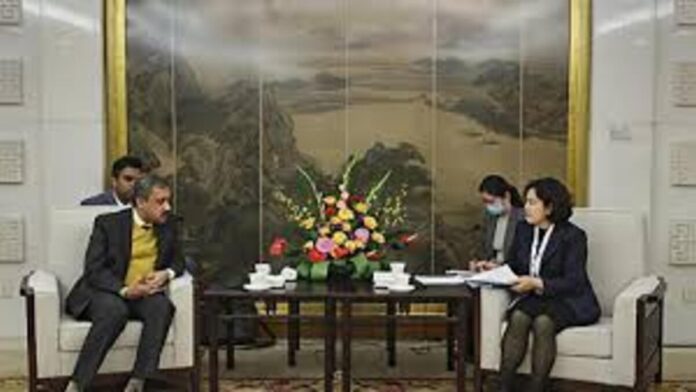
During the first visit by an Indian official delegation to Beijing in over three years, India and China discussed proposals for disengagement and improvement in the situation at the border where Indian and Chinese troops continue to be on stand-off at a couple of friction points on the Line of Actual Control.
The Working Mechanism for Consultation & Coordination on India-China Border Affairs (WMCC), which is under the direction of the foreign office, conducted its 26th meeting in Beijing on Wednesday. The 15th iteration of this framework took place in Beijing in July 2019, and this is the first “in-person” gathering since then.
It also represents the first official meeting between China and India since the outbreak of the pandemic and the ensuing standoff in 2020. Following the start of the stand-off, which resulted in the first fatalities at the border in 40 years, India has primarily frozen other bilateral mechanisms, with the exception of those linked to the border.
There have been at least two bilateral visits by top Chinese officials since disengagement at three of the six stand-off points, including foreign minister Wang Yi in March 2022 and China’s special envoy on Afghanistan in August 2022.
In order to attend the G-20 and SCO meetings this year, it is anticipated that Chinese President Xi Jinping will travel to India.
According to a readout from the ministry of foreign affairs, the two sides discussed the situation with the LAC in the western sector, which alludes to the standoff in eastern Ladakh.
The Indian statement claimed that there was discussion on “proposals for disengagement in the remaining areas in an open and constructive manner, which would help in the restoration of peace and tranquillity along the LAC in Western Sector and create conditions for restoration of normalcy in bilateral relations”.
According to the MEA note, India and China agreed to schedule the next round of top military commanders’ talks as soon as possible in order to achieve this goal “in accordance with existing bilateral agreements and protocols.”
The 18th round of military negotiations will take place as soon as feasible, according to the agreement, according to the readout of China’s foreign affairs ministry in Chinese.
Similar to prior meetings, the Chinese statement only mentioned the need to “further ease” the border situation into a “stage of normalization and control,” not that “disengagement” was necessary.
It demonstrated the divergent perspectives held by the two Asian sides regarding the unresolved border problems. India wishes to start with a disengagement at the two remaining flashpoints of friction at Depsang and Demchok, but China does not see this as a part of the current standoff.
China essentially asserted that the standoff was over following the disengagement at Patrolling Point 15 in September of last year, saying that the “phase of emergency response since the Galwan valley incident has basically come to an end.”