


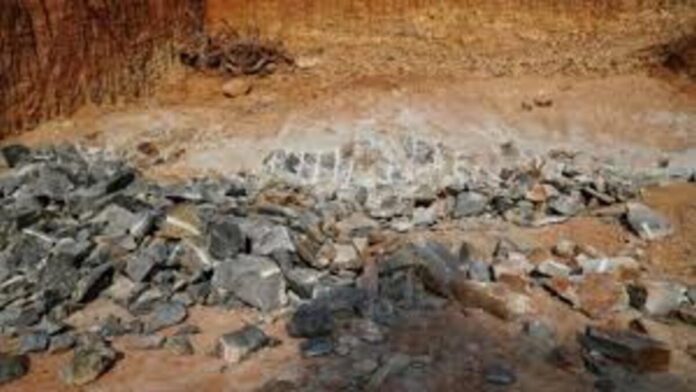
The Salal-Haimana area of the Reasi District of Jammu & Kashmir possesses 5.9 million tonnes of inferred lithium resources, according to the Geological Survey of India (GSI), which disclosed this on Thursday.
The Central Geological Programming Board (CGPB), a forum of the GSI where the Annual Field Season Program (FSP) is placed in front of representatives from the State and Central Governments, Mineral Exploration Agencies, PSUs, and Private Entrepreneurs, held its 62nd meeting, at which Mines Secretary Vivek Bharadwaj made the announcement.
Stages of Lithium Geological Exploration
Resources at the G3 level of preliminary exploration have been categorised by the GSI. There are four stages of exploration for every mineral deposit, according to The United Nations Framework Classification for Resources (UNFC): reconnaissance (G4), preliminary exploration (G3), general exploration (G2), and detailed exploration (G1).
The G4 stage of the mineral extraction process typically starts with the identification of mineralized areas deserving of further investigation and progresses to the G1 stage, which involves a thorough exploration and an accurate estimation of the deposit’s size, shape, structure, grade, and other characteristics.
Resource data is generated at each stage with distinct levels of geological assurance. A recent discovery of lithium deposits in the J&K region’s Reasi District is at the early exploration stage of geological assessment (G3). In order to extract lithium from salt-flat brines or mineral ores, the G3 stage is further divided into a six-step procedure.
Geological surveys in Stage 1 involve mapping on a larger scale and connecting prepared maps with a top grid. Lithology, structure, surface mineralization, ancient workings study, etc.
Stage 2: Conduct soil surveys and geochemical sampling based on rock type.
Stage 3: Extensive drill logging and ground geophysical work.
Stage 4: Examine the technicalities of the pits or trenches used to investigate the mineralized zone and determine drill holes spacing
Stage 5: Pit/trench, core, and litho geochemical sampling from a well-known region
Stage 6: Petrographic and mineralogical studies, which combine the analysis of thin sections of rocks with the study of the chemistry, crystal structure, and physical characteristics of the minerals that make up rocks.
According to the Indian Bureau of Mines (IBM), the proposal to mine minerals must be evaluated from a feasibility point of view along with the prospects for economic viability in addition to a complete assessment of the aforementioned geological axis.
Road to India’s zero carbon emission via Lithium route
Water and lithium, a delicate, silvery-white metal, react violently. Much of what we do in our daily lives depends on lithium. Prime Minister Narendra Modi promised to reduce India’s emissions to net zero by 2070 during the 26th UN Conference of the Parties on Climate Change (COP26) in Glasgow in 2021.
India’s amended Nationally Determined Contribution (NDC), which will be submitted to the United Nations Framework Convention on Climate Change, has already been approved by the Indian government (UNFCCC). In the future, Lithium supply will be essential for such aims. Another essential component of electric vehicle (EV) batteries is lithium, however the World Economic Forum (WEF) reports that “world supplies are under pressure due to increased EV demand.” By 2025, the International Energy Agency (IEA) predicts that there may be a lithium shortage worldwide.
Although the IEA predicts that by 2050, the world would need to have around 2 billion electric vehicles (EVs), EV sales in 2021 were just 6.6 million. In addition to the fact that resources are concentrated in a few locations and that more than half of current production takes place in regions with significant water stress, lithium supply confronts constraints. Future advancements in battery technology or production techniques may eventually help to reduce some lithium shortages, according to a WEF assessment.
Other applications for lithium outside of electric vehicles (EVs) include rechargeable batteries for cell phones, laptops, digital cameras, computers, power tools, and energy storage for wind and solar energy.
Some non-rechargeable batteries, including those in toys, clocks, and heart pacemakers, also use lithium. By 2030, India would require 27 GW of grid-scale battery energy storage systems, according to the Central Electricity Authority. However, a lot of lithium will be needed for this.
14 exploration projects on lithium and related elements were conducted in Bihar, Chhattisgarh, Himachal Pradesh, Jammu & Kashmir, Jharkhand, Madhya Pradesh, Meghalaya, Karnataka, and Rajasthan between 2016 and 2021, according to official statistics. Five projects using lithium and related minerals were carried out in the Indian states of Arunachal Pradesh, Andhra Pradesh, Chhattisgarh, Jammu & Kashmir, and Rajasthan between 2021 and 2022. The explorations have shown evidence of lithium in Mandya, in the state of Karnataka.
According to government data, 69% of India’s total lithium imports between 2020 and 21 came from China and Hong Kong, suggesting that India was mostly dependent on these two countries for its lithium needs.
Most of the reserves that have been found so far around the world are in Chile, Australia, Argentina, Bolivia, and China. Argentina, Bolivia, and Chile contain 54% of the world’s lithium reserves, which are located in South America. The region, sometimes known as the “Lithium Triangle,” is centred in a number of salt pans found in the Atacama Desert and nearby arid areas.
Currently, the world’s top four mining companies—Albemarle, SQM, Tianqi, and FMC—control one-third of the lithium industry. In addition to its own local mines, China has constructed other lithium mines abroad to guarantee a consistent supply. India’s goal for energy independence in terms of green technology is hampered by the monopoly over the supply of lithium.
As there is still some time between the current exploration stage and a potential extraction process, it is too soon to make any comments on the new discovery of lithium resources in J&K. Such extractions are also linked to environmental issues that need to be carefully addressed.