


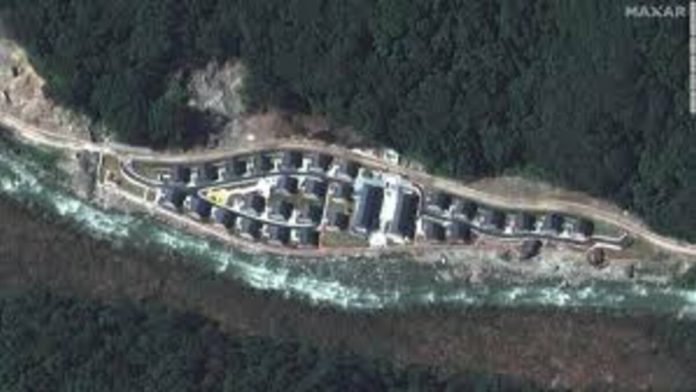
According to satellite imageries, Chinese village 9 km East of Doklam plateau, where 2017 standoff between India and China happened, is not fully occupied with parked cars.
The village named Pangda, sqaurely lies in Bhutanese territory, it was earlier reported in 2021.
Close by Pangda is a conveniently marked all-weather carriageway, some portion of China’s broad land-acquisition in Bhutan. This cuts 10 km into Bhutanese domain, along the banks of the fast streaming Amo Chu river.
For India, any construction along the Amo Chu implies that Chinese powers could wind up gaining access to an essential edge in the nearby Doklam level. This would provide them with an immediate view to India’s delicate Siliguri corridor, the thin bit of land that links the upper east states with the other parts of the country.
During the standoff in 2017, the Indian soldiers had restricted the Chinese workers from getting the ridge in Doklam called the Jhamperi. It is now speculated that China is intending to pass through the Indian defences to the West by entering the same ridge but from a different route.
“Pangda village and the ones to its North and South are a classic examples of the Chinese trying to establish their legitimacy over the Jhamperi ridge and the Doklam plateau,” said Lt General Praveen Bakshi now retired, who was serving as the India’s Eastern Army Commander in 2017 when the Doklam standoff took place. These acts by China for constructing villages along the areas that if disputes is ”essentially a manner of giving legitimacy to its territorial claims.”
“The Army maintains a continuous and seamless vigil on all activities along its borders, especially those that impinge upon the territorial integrity and sovereignty of the nation. For this, necessary mechanisms and safeguards to meet any contingencies are in place,” sources from Army headquarters told media.
The new set of satellite imageries, obtained from Maxar, points out that a second village in the Amo Chu river valley is presently basically complete while China has moved forward development of a third village or residence further South. A bridge is also visible across the Amo Chu constructed around the third village. The groundworks of six buildings here are noticeable.
“The speed and development of this remote area is noteworthy, underlining how China is extending its borders uncontested,” says Damien Symon, a geospatial intelligence researcher at The Intel Lab who has analysed the latest images. “The road construction activity in this distant, isolated sector highlights efforts taken by China to ensure all weather, uninterrupted connectivity to remote, new habitats across its frontier,” he further said.
Bhutan, a little land-locked country, has essentially no capacity to restrict China’s ‘salami-slicing’ of its region. Bhutan’s Ambassador to New Delhi, Major General Vetsop Namgyal, declined to speak anything on the territory of China’s development in the Amo Chu Valley, demonstrating that Thimpu was engaged with extended line talks. India’s Ministry of External Affairs also had nothing to speak on the new turns of events.
China’s road and village development action in the Amo Chu waterway valley lies roughly 30 km south of Beijing’s greatest land acquisition, which has been seen over the last one year. Six settlements have been developed in a formerly uninhabited region in a 110-square km parcel of land which Beijing challenges. These settlements pressurise the Indian safeguards in Sikkim.
”China is stepping up construction of villages, roads and security installations on territory that belongs to Bhutan, thereby strengthening its offensive military capability against India,” one of India’s leading China- watchers Dr. Brahma Chellaney said ”Through such build-up, China is militarily positioning itself to threaten a particularly vulnerable section of India’s border overlooking a narrow corridor known as the ‘Chicken Neck’,” he added.
This new development comes amid when India is still persuading China to withdraw its position from occupying Ladakh since 2020. So far, 16 rounds of talks between India and China have been held but no significant conclusion has arrived yet, the last round of talk was on Sunday.