


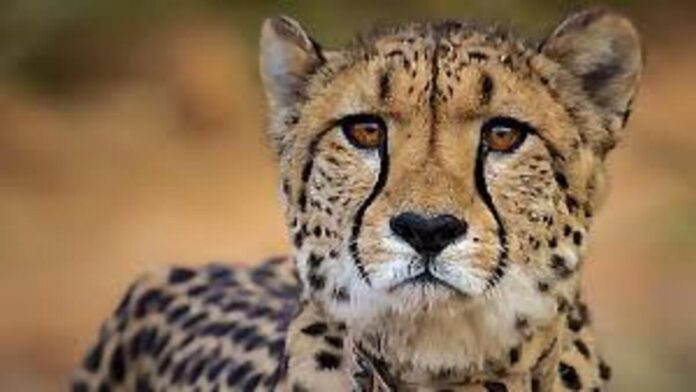
The Union Ministry of Environment, Forests, and Climate Change said on Monday that five more cheetahs — three females and two males — will be released from acclimatisation camps into free-roaming circumstances at Madhya Pradesh’s Kuno National Park (KNP) before the monsoon season begins in June.
The ministry also stated in a statement that Uday, the male adult South African cheetah found dead at KNP on April 23, died of cardio-pulmonary failure, and that a complete postmortem study revealed that it did not have any infectious condition that could have affected other cheetahs.
Uday died less than a week after being transferred from the Boma (quarantine cage) to the larger enclosure within KNP.
The ministry reaffirmed the Madhya Pradesh Forest Department’s earlier statement that Uday was staggering around “in an uncoordinated manner and was unable to lift his head.” The veterinary staff anaesthetized him and treated him symptomatically. Blood and other samples were taken to be sent to the lab for analysis, but he died that afternoon.
So far, four Namibian cheetahs have been released from walled acclimatisation camps in KNP. The monitoring teams chose the five animals for release immediately based on their behavioural features and approachability, according to the statement. The remaining ten cheetahs would be kept in acclimatisation camps for the length of the monsoon, according to the statement.
The situation will be evaluated once the monsoon season ends in September, according to the ministry.
According to the ministry, the decision was made after a team of specialists examined the status of “Project Cheetah” in accordance with National Tiger Conservation Authority (NTCA) guidelines. Prof Adrian Tordiffe, veterinary wildlife specialist from the University of Pretoria in South Africa, was part of the team, as was Vincent van dan Merwe, manager of the Cheetah Metapopulation Project in South Africa, Qamar Qureshi, head scientist at the Wildlife Institute of India, and Amit Mallick, I-G Forests, NTCA. On April 30, the team visited Kuno and presented its report to the minister.
The scientists noted that it is “impossible to determine” the exact cheetah-carrying capacity at KNP “until cheetahs have properly established their home ranges.” According to the paper, cheetah home-range sizes and population density can vary “tremendously for different cheetah populations in Africa, and for obvious reasons, we do not yet have useful spatial ecology data for cheetahs in India.”
The ministry reported following Uday’s death that the initial autopsy “revealed that he had most likely died of terminal cardio-pulmonary failure” and that the remainder of his organ tissues “appeared to be relatively normal except for a localised area of potential haemorrhage in his brain.” There were no other indicators of infection or damage.
Sasha, a Namibian female cheetah, died in March of severe renal failure. Unlike Uday, she got renal disease while imprisoned in Namibia, according to experts. She was never allowed to leave quarantine.